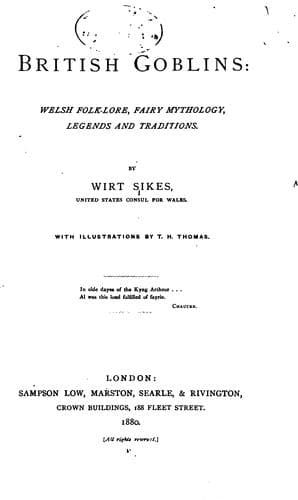
British Goblins: Welsh Folk-lore, Fairy Mythology, Legends and TraditionsSikes, Wirt
History
British Goblins: Welsh Folk-lore, Fairy Mythology, Legends and Traditions
Sikes, Wirt
Folklore -- Wales; Goblins -- Wales; Mythology, Celtic -- Wales; Mythology, Welsh; Wales -- Social life and customs
preach at some anniversary, or quarterly meeting, and he would answer,
"I cannot, on that day; the rain will descend in torrents, and there
will be no congregation." He would give the last mite he possessed to
the needy, and tell his wife, "God will send a messenger with food and
raiment at nine o'clock to-morrow." And so it would be.' He was a
thorough-going believer in Welsh fairies, and full of indignant scorn
toward all who dared question their reality. To him these phantoms
were part and parcel of the Christian faith, and those who disbelieved
in them were denounced as Sadducees and infidels.
FOOTNOTE:
[50] 'Fairy Mythology,' 412.
III.
With regard to the fairy rings, Jones held that the Bible alludes to
them, Matt. xii. 43: 'The fairies dance in circles in dry places; and
the Scripture saith that the walk of evil spirits is in dry places.'
They favour the oak-tree, and the female oak especially, partly
because of its more wide-spreading branches and deeper shade, partly
because of the 'superstitious use made of it beyond other trees' in
the days of the Druids. Formerly, it was dangerous to cut down a
female oak in a fair dry place. 'Some were said to lose their lives by
it, by a strange aching pain which admitted of no remedy, as one of my
ancestors did; but now that men have more knowledge and faith, this
effect follows not.' William Jenkins was for a long time the
schoolmaster at Trefethin church, in Monmouthshire, and coming home
late in the evening, as he usually did, he often saw the fairies under
an oak within two or three fields from the church. He saw them more
often on Friday evenings than any other. At one time he went to
examine the ground about this oak, and there he found the reddish
circle wherein the fairies danced, 'such as have often been seen under
the female oak, called Brenhin-bren.' They appeared more often to an
uneven number of persons, as one, three, five, &c.; and oftener to men
than to women. Thomas William Edmund, of Hafodafel, 'an honest pious
man, who often saw them,' declared that they appeared with one bigger
than the rest going before them in the company. They were also heard
talking together in a noisy, jabbering way; but no one could
distinguish the words. They seemed, however, to be a very disputatious
race; insomuch, indeed, that there was a proverb in some parts of
Wales to this effect: 'Ni chytunant hwy mwy na Bendith eu Mamau,'
(They will no more agree than the fairies).
IV.
Public-domain text, read in full here on John Shaqi.
Reviews
Reviews
No reviews yet
Be the first to share your thoughts on this work.
Elsewhere in the archive
Join the Discussion
Join the discussion
Sign in to leave a comment or review.
Sign InorCreate an account