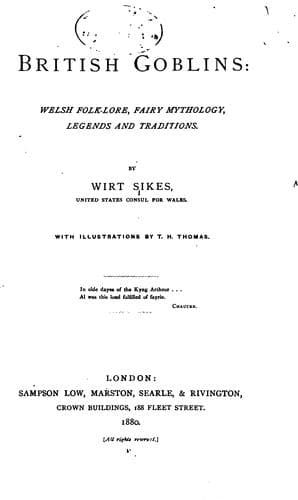
British Goblins: Welsh Folk-lore, Fairy Mythology, Legends and TraditionsSikes, Wirt
History
British Goblins: Welsh Folk-lore, Fairy Mythology, Legends and Traditions
Sikes, Wirt
Folklore -- Wales; Goblins -- Wales; Mythology, Celtic -- Wales; Mythology, Welsh; Wales -- Social life and customs
Origins of Welsh Fairies--The Realistic Theory--Legend of
the Baron's Gate--The Red Fairies--The Trwyn Fairy a
Proscribed Nobleman--The Theory of hiding Druids--Colour in
Welsh Fairy Attire--The Green Lady of Caerphilly--White the
favourite Welsh Hue--Legend of the Prolific Woman--The
Poetico-Religious Theory--The Creed of Science.
I.
Concerning the origin of the Tylwyth Teg, there are two popular
explanations, the one poetico-religious in its character, the other
practical and realistic. Both are equally wide of the truth, the true
origin of fairies being found in the primeval mythology; but as my
purpose is to avoid enlarging in directions generally familiar to the
student, I have only to present the local aspects of this, as of the
other features of the subject.
The realistic theory of the origin of the Tylwyth Teg must be
mentioned respectfully, because among its advocates have been men of
culture and good sense. This theory presumes that the first fairies
were men and women of mortal flesh and blood, and that the later
superstitions are a mere echo of tales which first were told of real
beings. In quasi-support of this theory, there is a well-authenticated
tradition of a race of beings who, in the middle of the sixteenth
century, inhabited the Wood of the Great Dark Wood (Coed y Dugoed
Mawr) in Merionethshire, and who were called the Red Fairies. They
lived in dens in the ground, had fiery red hair and long strong arms,
and stole sheep and cattle by night. There are cottages in Cemmaes
parish, near the Wood of the Great Dark Wood, with scythes in the
chimneys, which were put there to keep these terrible beings out. One
Christmas eve a valiant knight named Baron Owen headed a company of
warriors who assailed the Red Fairies, and found them flesh and blood.
The Baron hung a hundred of them; but spared the women, one of whom
begged hard for the life of her son. The Baron refused her prayer,
whereupon she opened her breast and shrieked, 'This breast has nursed
other sons than he, who will yet wash their hands in thy blood, Baron
Owen!' Not very long thereafter, the Baron was waylaid at a certain
spot by the sons of the 'fairy' woman, who washed their hands in his
warm and reeking blood, in fulfilment of their mother's threat. And to
this day that spot goes by the name of Llidiart y Barwn (the Baron's
Gate); any peasant of the neighbourhood will tell you the story, as
one told it to me. There is of course no better foundation for the
fairy features of it than the fancies of the ignorant mind, but the
legend itself is--very nearly in this shape--historical. The beings in
question were a band of outlaws, who might naturally find it to their
interest to foster belief in their supernatural powers.
II.
Public-domain text, read in full here on John Shaqi.
Reviews
Reviews
No reviews yet
Be the first to share your thoughts on this work.
Elsewhere in the archive
Join the Discussion
Join the discussion
Sign in to leave a comment or review.
Sign InorCreate an account