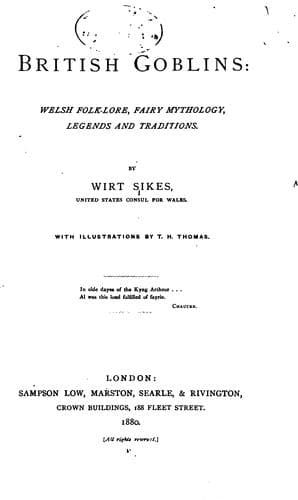
British Goblins: Welsh Folk-lore, Fairy Mythology, Legends and TraditionsSikes, Wirt
History
British Goblins: Welsh Folk-lore, Fairy Mythology, Legends and Traditions
Sikes, Wirt
Folklore -- Wales; Goblins -- Wales; Mythology, Celtic -- Wales; Mythology, Welsh; Wales -- Social life and customs
The so-called Pwca'r Trwyn, which haunted the farm-house in the parish
of Mynyddyslwyn, is sometimes cited as another case in which a fairy
was probably a being of flesh and blood; and if this be true, it of
course proves nothing but the adoption of an ancient superstition by a
proscribed Welsh nobleman. There is a tradition that this fairy had a
name, and that this name was 'yr Arglwydd Hywel,' which is in English
'Lord Howell.' And it is argued that this Lord, in a contest with the
forces of the English king, was utterly worsted, and driven into
hiding; that his tenants at Pantygasseg and the Trwyn Farm, loving
their Lord, helped to hide him, and to disseminate the belief that he
was a household fairy, or Bwbach. It is related that he generally
spoke from his own room in this farm-house, in a gentle voice which
'came down between the boards' into the common room beneath. One day
the servants were comparing their hands, as to size and whiteness,
when the fairy was heard to say, 'The Pwca's hand is the fairest and
smallest.' The servants asked if the fairy would show its hand, and
immediately a plank overhead was moved and a hand appeared, small,
fair and beautifully formed, with a large gold ring on the little
finger.
III.
Curiously interesting is the hypothesis concerning the realistic
origin of the Tylwyth Teg, which was put forth at the close of the
last century by several writers, among them the Rev. Peter Roberts,
author of the 'Collectanea Cambrica.' This hypothesis precisely
accounts for the fairies anciently as being the Druids, in hiding from
their enemies, or if not they, other persons who had such cause for
living concealed in subterraneous places, and venturing forth only at
night. 'Some conquered aborigines,' thought Dr. Guthrie; while Mr.
Roberts fancied that as the Irish had frequently landed hostilely in
Wales, 'it was very possible that some small bodies of that nation
left behind, or unable to return, and fearing discovery, had hid
themselves in caverns during the day, and sent their children out at
night, fantastically dressed, for food and exercise, and thus secured
themselves.' But there were objections to this presumption, and the
Druidical theory was the favourite one. Says Mr. Roberts: 'The fairy
customs appeared evidently too systematic, and too general, to be
those of an accidental party reduced to distress. They are those of a
consistent and regular policy instituted to prevent discovery, and to
inspire fear of their power, and a high opinion of their beneficence.
Accordingly tradition notes, that to attempt to discover them was to
incur certain destruction. "They are fairies," says Falstaff: "he that
looks on them shall die." They were not to be impeded in ingress or
egress; a bowl of milk was to be left for them at night on the hearth;
and, in return, they left a small present in money when they departed,
if the house was kept clean; if not, they inflicted some punishment on
Public-domain text, read in full here on John Shaqi.
Reviews
Reviews
No reviews yet
Be the first to share your thoughts on this work.
Elsewhere in the archive
Join the Discussion
Join the discussion
Sign in to leave a comment or review.
Sign InorCreate an account