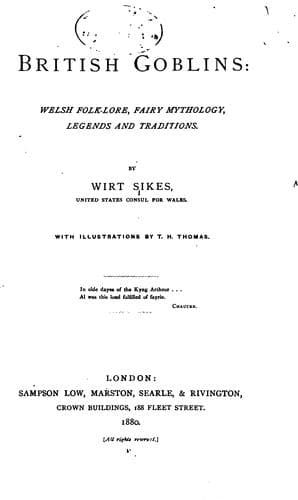
British Goblins: Welsh Folk-lore, Fairy Mythology, Legends and TraditionsSikes, Wirt
History
British Goblins: Welsh Folk-lore, Fairy Mythology, Legends and Traditions
Sikes, Wirt
Folklore -- Wales; Goblins -- Wales; Mythology, Celtic -- Wales; Mythology, Welsh; Wales -- Social life and customs
It will be observed that one of the points in this curious speculation
rests on the green dress of the fairies. I do not call attention to it
with any Quixotic purpose of disputing the conclusion it assists; it
is far more interesting as one feature of the general subject of
fairies' attire. The Welsh fairies are described with details as to
colour in costume not commonly met with in fairy tales, a fact to
which I have before alluded. In the legend of the Place of Strife,
the Tylwyth Teg encountered by the women are called 'the old elves of
the blue petticoat.' A connection with the blue of the sky has here
been suggested. It has also been pointed out that the sacred Druidical
dress was blue. The blue petticoat fancy seems to be local to North
Wales. In Cardiganshire, the tradition respecting an encampment called
Moyddin, which the fairies frequented, is that they were always in
green dresses, and were never seen there but in the vernal month of
May. There is a Glamorganshire goblin called the Green Lady of
Caerphilly, the colour of whose dress is indicated by her title. She
haunts the ruin of Caerphilly Castle at night, wearing a green robe,
and has the power of turning herself into ivy and mingling with the
ivy growing on the wall. A more ingenious mode of getting rid of a
goblin was perhaps never invented. The fairies of Frennifawr, in
Pembrokeshire, were on the contrary gorgeous in scarlet, with red
caps, and feathers waving in the wind as they danced. But others were
in white, and this appears to be the favourite hue of modern Welsh
fairy costume, when the Tylwyth Teg are in holiday garb. These various
details of colour are due to the fervour of the Welsh fancy, of
course, and perhaps their variety may in part be ascribed to a keener
sense of the fitness of things among moderns than was current in
earlier times. White, to the Welsh, would naturally be the favourite
colour for a beautiful creature, dancing in the moonlight on the
velvet sward. The most popular pet name for a Welsh lass is to-day
exactly what it has been for centuries, viz., Gwenny, the diminutive
of Gwenllian (Anglicised into Gwendoline)--a name which means simply
white linen; and the white costume of the favourite fairies
undoubtedly signifies a dress of white linen. This fabric, common as
it is in our day, was in ancient times of inestimable value. In the
Mabinogion, linen is repeatedly particularised in the gorgeous
descriptions of fabled splendour in princely castles--linen, silk,
satin, velvet, gold-lace, and jewels, are the constantly-recurring
features of sumptuous attire. In his account of the royal tribes of
Wales, Yorke mentions that linen was so rare in the reign of Charles
VII. of France (i.e., in the fifteenth century) 'that her majesty the
queen could boast of only two shifts of that commodity.' The first
cause of the fairies' robes being white is evidently to be discerned
here; and in Wales the ancient sentiment as to whiteness remains. The
Public-domain text, read in full here on John Shaqi.
Reviews
Reviews
No reviews yet
Be the first to share your thoughts on this work.
Elsewhere in the archive
Join the Discussion
Join the discussion
Sign in to leave a comment or review.
Sign InorCreate an account