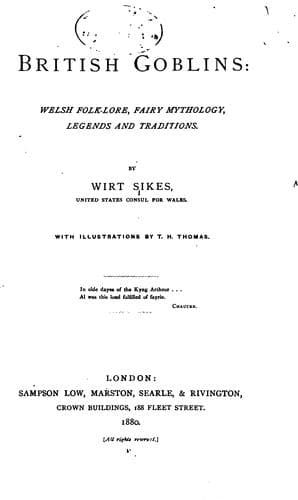
British Goblins: Welsh Folk-lore, Fairy Mythology, Legends and TraditionsSikes, Wirt
History
British Goblins: Welsh Folk-lore, Fairy Mythology, Legends and Traditions
Sikes, Wirt
Folklore -- Wales; Goblins -- Wales; Mythology, Celtic -- Wales; Mythology, Welsh; Wales -- Social life and customs
With regard to other divisions of the field of folk-lore, the views of
scholars differ, but in the realm of faerie these differences are
reconciled; it is agreed that fairy tales are relics of the ancient
mythology; and the philosophers stroll hand in hand harmoniously. This
is as it should be, in a realm about which cluster such delightful
memories of the most poetic period of life--childhood, before
scepticism has crept in as ignorance slinks out. The knowledge which
introduced scepticism is infinitely more valuable than the faith it
displaced; but, in spite of that, there be few among us who have not
felt evanescent regrets for the displacement by the _foi scientifique_
of the old faith in fairies. There was something so peculiarly
fascinating in that old belief, that 'once upon a time' the world was
less practical in its facts than now, less commonplace and humdrum,
less subject to the inexorable laws of gravitation, optics, and the
like. What dramas it has yielded! What poems, what dreams, what
delights!
But since the knowledge of our maturer years destroys all that, it is
with a degree of satisfaction we can turn to the consolations of the
fairy mythology. The beloved tales of old are 'not true'--but at least
they are not mere idle nonsense, and they have a good and sufficient
reason for being in the world; we may continue to respect them. The
wit who observed that the final cause of fairy legends is 'to afford
sport for people who ruthlessly track them to their origin,'[1]
expressed a grave truth in jocular form. Since one can no longer rest
in peace with one's ignorance, it is a comfort to the lover of fairy
legends to find that he need not sweep them into the grate as so much
rubbish; on the contrary they become even more enchanting in the
crucible of science than they were in their old character.
FOOTNOTE:
[1] 'Saturday Review,' October 20, 1877.
II.
Public-domain text, read in full here on John Shaqi.
Reviews
Reviews
No reviews yet
Be the first to share your thoughts on this work.
Join the Discussion
Join the discussion
Sign in to leave a comment or review.
Sign InorCreate an account