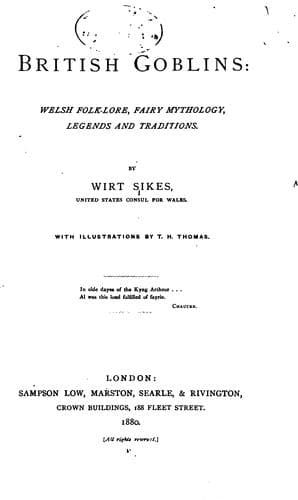
British Goblins: Welsh Folk-lore, Fairy Mythology, Legends and TraditionsSikes, Wirt
History
British Goblins: Welsh Folk-lore, Fairy Mythology, Legends and Traditions
Sikes, Wirt
Folklore -- Wales; Goblins -- Wales; Mythology, Celtic -- Wales; Mythology, Welsh; Wales -- Social life and customs
Among the vulgar in Wales, the belief in fairies is less nearly
extinct than casual observers would be likely to suppose. Even
educated people who dwell in Wales, and have dwelt there all their
lives, cannot always be classed as other than casual observers in this
field. There are some such residents who have paid special attention
to the subject, and have formed an opinion as to the extent of
prevalence of popular credulity herein; but most Welsh people of the
educated class, I find, have no opinion, beyond a vague surprise that
the question should be raised at all. So lately as the year 1858, a
learned writer in the 'Archæologia Cambrensis' declared that 'the
traveller may now pass from one end of the Principality to the other,
without his being shocked or amused, as the case may be, by any of the
fairy legends or popular tales which used to pass current from father
to son.' But in the same periodical, eighteen years later, I find Mr.
John Walter Lukis (President of the Cardiff Naturalists' Society),
asserting with regard to the cromlechs, tumuli, and ancient camps in
Glamorganshire: 'There are always fairy tales and ghost stories
connected with them; some, though _fully believed in_ by the
inhabitants of those localities, are often of the most absurd
character; in fact, the more ridiculous they are, the more they are
believed in.'[2] My own observation leads me to support the testimony
of the last-named witness. Educated Europeans generally conceive that
this sort of belief is extinct in their own land, or, at least their
own immediate section of that land. They accredit such degree of
belief as may remain, in this enlightened age, to some remote part--to
the south, if they dwell in the north; to the north, if they dwell in
the south. But especially they accredit it to a previous age: in
Wales, to last century, or the middle ages, or the days of King
Arthur. The rector of Merthyr, being an elderly man, accredits it to
his youth. 'I am old enough to remember,' he wrote me under date of
January 30th, 1877, 'that these tales were thoroughly believed in
among country folk forty or fifty years ago.' People of superior
culture have held this kind of faith concerning fairy-lore, it seems
to me, in every age, except the more remote. Chaucer held it, almost
five centuries ago, and wrote:[3]
In olde dayes of the Kyng Arthour, ...
Al was this lond fulfilled of fayrie; ...
I speke of many hundrid yer ago;
But now can no man see non elves mo.
Dryden held it, two hundred years later, and said of the fairies:
I speak of ancient times, for now the swain
Returning late may pass the woods in vain,
And never hope to see the nightly train.
Public-domain text, read in full here on John Shaqi.
Reviews
Reviews
No reviews yet
Be the first to share your thoughts on this work.
Join the Discussion
Join the discussion
Sign in to leave a comment or review.
Sign InorCreate an account