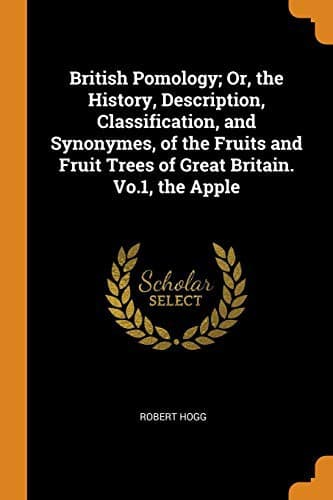
British Pomology: Or, the History, Description, Classification, and Synonymes, of the Fruits and Fruit Trees of Great Britain — John Shaqi
British Pomology: Or, the History, Description, Classification, and Synonymes, of the Fruits and Fruit Trees of Great BritainHogg, Robert
History
British Pomology: Or, the History, Description, Classification, and Synonymes, of the Fruits and Fruit Trees of Great Britain
Hogg, Robert
Apples
A culinary apple of the first quality, in use from August to December.
It is one of the most useful as well as one of the best culinary apples
we have, being fit for use when no larger than a walnut, and after
perfecting their growth continuing in perfection as late as Christmas.
If blanched in warm water, when used small, the outer rind slips off,
and they may be baked whole; their color is then a transparent green;
and their flavor is exquisite, resembling that of a green apricot.
When it is about the size of a large nutmeg, it may be made into apple
marmalade, or a dried sweetmeat, which rivals the finest Portugal
plum.--_M.C.H.S._
The tree is very hardy, a free grower, and an abundant bearer. As it
does not attain a great size, it may be grown more closely together
than most other sorts. It is a dwarf variety of the old English Codlin.
63. CAROLINE.--Lind.
IDENTIFICATION.--Lind. Guide, 41. Hort. Trans. vol. iv., p. 66. Hort.
Soc. Cat. ed. 3, n. 128.
Fruit, medium sized; roundish. Skin, fine rich deep yellow, streaked
with broad patches of red. Eye, small, set in a narrow and plaited
basin. Stalk, short, inserted in a shallow cavity, which is lined with
russet. Flesh, firm, brisk, juicy, and highly flavored.
A culinary apple of first-rate quality, in use from November to
February.
This variety was named in honor of Lady Caroline Suffield, the wife of
Lord Suffield, of Blickling and Gunton Hall, Norfolk.--_Lindley._
64. CATSHEAD.--Ray.
IDENTIFICATION.--Raii Hist. ii. 1447, n. 8. Lind. Guide, 65. Down. Fr.
Amer. 103. Hort. Soc. Cat. ed. 3, n. 130.
SYNONYME.--Cat’s Head, _Fors. Treat._ 97.
Fruit, large, three inches and a quarter broad, and the same in height;
oblong, nearly as broad at the apex as at the base, with prominent ribs
on the sides, which extend into the basin of the eye, and terminate
in several knobs. Skin, smooth and unctuous, pale green; but with a
brownish tinge next the sun, and strewed with minute russety dots. Eye,
large and open, set in a large, angular, and rather deep basin. Stalk,
short, and slender for the size of the fruit, inserted in a shallow and
angular cavity. Flesh, tender, juicy, and sweet, with a pleasant, acid,
and slightly perfumed flavor.
One of our oldest and best culinary apples; it is in use from October
to January.
The tree is a strong and vigorous grower, and attains the largest
size, and though not an abundant bearer during the early period of its
growth, it is much more productive as it becomes aged.
In the Horticultural Society’s Catalogue of Fruits, and also in
Lindley’s “Guide to the Orchard.” This is made synonymous with the
Costard of Ray, which is undoubtedly an error, the Costard being a
distinct variety.
The Catshead is one of our oldest varieties, and was always highly
esteemed for its great size. Phillips, in his poem on Cyder, says--
Public-domain text, read in full here on John Shaqi.
Reviews
Reviews
No reviews yet
Be the first to share your thoughts on this work.
Join the Discussion
Join the discussion
Sign in to leave a comment or review.
Sign InorCreate an account