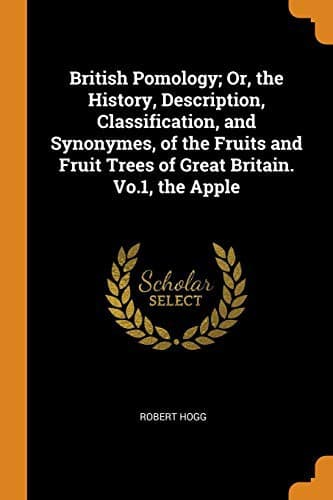
British Pomology: Or, the History, Description, Classification, and Synonymes, of the Fruits and Fruit Trees of Great BritainHogg, Robert
History
British Pomology: Or, the History, Description, Classification, and Synonymes, of the Fruits and Fruit Trees of Great Britain
Hogg, Robert
Apples
Fruit, medium sized, three inches broad, and two inches and a half
high; oblate, narrowing from the base to the crown. Skin, pale yellow,
but pale red striped with crimson where exposed to the sun, and covered
with large russety spots. Eye, small, and partially closed with broad
segments, and set in a pretty deep basin. Stalk, three quarters of an
inch long, slender, inserted in a deep, funnel-shaped, and russety
cavity. Flesh, yellowish white, tender, soft, and juicy, with a
pleasant, sugary, and perfumed flavor.
A dessert apple of second-rate quality; in use from October to
Christmas.
The tree is hardy, a free grower, a good bearer, and attains a
considerable size. It is said to be extensively cultivated in the
neighbourhood of Chester.
68. CHRISTIE’S PIPPIN.--Hort.
IDENTIFICATION.--Hort. Soc. Cat. ed. 3, n. 10. Lind. Guide, 12. Rog.
Fr. Cult. 84.
FIGURE.--Ron. Pyr. Mal. pl. xli. f. 3.
Fruit, medium sized, two inches and a half wide, and two inches high;
oblate, without angles, and handsomely shaped. Skin, yellow, tinged
with green on the shaded side; but streaked and mottled with red next
the sun, and speckled all over with large russety dots. Eye, partially
closed, set in a round, even, and rather shallow basin. Stalk, short
and slender, not protruding beyond the margin, inserted in a deep
cavity, which is lined with russet. Flesh, yellowish white, tender,
brisk, juicy, sugary, and pleasantly flavored.
A dessert apple of the first quality; in use from December to February.
The tree is an abundant bearer, but constitutionally weak, a delicate
grower, and subject to canker and mildew. On the paradise stock it
forms a beautiful, compact, and handsome little pyramid.
It was raised by a Mr. Christie, at Kingston-on-Thames.
69. CLAYGATE PEARMAIN.--Hort.
IDENTIFICATION.--Hort. Trans. vol. v. p. 402. Lind. Guide, 65. Hort.
Soc. Cat. ed. 3, n. 538. Down. Fr. Amer. 122.
Fruit, medium sized; pearmain-shaped. Skin, dull yellow mixed with
green, and a thin coating of russet and numerous dots on the shaded
side; but marked with broken stripes of dark red, on the side exposed
to the sun. Eye, large and open, with long segments set in a deep
basin. Stalk, an inch long, inserted in a smooth and rather deep
cavity. Flesh, yellowish, crisp, juicy, rich, and sugary, partaking of
the flavor of the Ribston Pippin.
A valuable and highly esteemed dessert apple of the first quality; it
comes into use in November, and will continue till March.
The tree, though not a strong or vigorous grower, is hardy and healthy,
attains the middle size, and is an abundant bearer. It succeeds well
grafted on the paradise stock, and grown as an espalier or an open
dwarf. Its shoots are slender and drooping.
This excellent variety was discovered by John Braddick, Esq., growing
in a hedge near his residence at Claygate, a hamlet in the parish of
Thames Ditton, in Surry, and by him widely and freely distributed.
70. CLARA PIPPIN.--Thomp.
Public-domain text, read in full here on John Shaqi.
Reviews
Reviews
No reviews yet
Be the first to share your thoughts on this work.
Join the Discussion
Join the discussion
Sign in to leave a comment or review.
Sign InorCreate an account