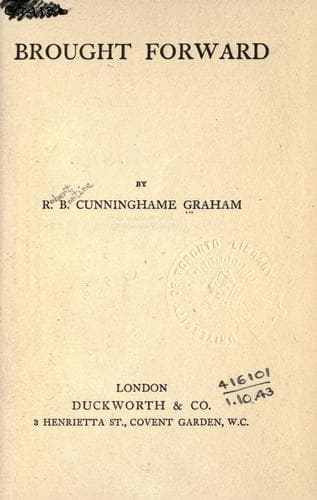
Brought ForwardCunninghame Graham, R. B. (Robert Bontine)
History
Brought Forward
Cunninghame Graham, R. B. (Robert Bontine)
Fiction; Short stories
The group of horsemen on the bluff rode slowly down towards the river’s
edge to watch the evolutions of the tug, and to hold back the horses when
they should be disembarked. By this time she had got so near that we
could see the horses’ heads looking out wildly from the sparred sides of
the great decked lighters, and hear the thunderous noise their feet made
tramping on the decks. Passing the bay, into which ran the stream, by
about three hundred yards, the tug cast off one of the lighters she was
towing, in a backwater. There it remained, the current slowly bearing it
backwards, turning round upon itself. In the wild landscape, with
ourselves upon our horses forming the only human element, the gigantic
lighter with its freight of horses looked like the ark, as set forth in
some old-fashioned book on Palestine. Slowly the tug crept in, the
Indian-looking pilot squatted in his canoe sounding assiduously with his
long cane. As the tug drew about six feet of water and the lighter not
much more than three, the problem was to get the lighter near enough to
the bank, so that when the hawser was cast off she would come in by her
own way. Twice did the tug ground, and with furious shoutings and with
all the crew staving on poles, was she got off again. At last the pilot
found a little deeper channel, and coming to about some fifty feet away,
lying a length or two above the spot where the stream entered the great
river, she paid her hawser out, and as the lighter drifted shorewards,
cast it off, and the great ark, with all its freight, grounded quite
gently on the little sandy beach. The Italian captain of the tug, a
Genoese, with his grey hair as curly as the wool on a sheep’s back,
wearing a pale pink shirt, neatly set off with yellow horseshoes, and a
blue gauze necktie tied in a flowing bow, pushed off his dirty little
boat, rowed by a negro sailor and a Neapolitan, who dipped their oars
into the water without regard to one another, either as to time or
stroke.
The captain stepped ashore, mopping his face with a yellow
pocket-handkerchief, and in the jargon between Spanish and Italian that
men of his sort all affect out in the River Plate, saluted us, and cursed
the river for its sandbanks and its turns, and then having left it as
accursed as the Styx or Periphlegethon, he doubly cursed the Custom
House, which, as he said, was all composed of thieves, the sons of
thieves, who would be certainly begetters of the same. Then he calmed
down a little, and drawing out a long Virginia cigar, took out the straw
with seriousness and great dexterity, and then allowed about a quarter of
an inch of it to smoulder in a match, lighted it, and sending out a cloud
of smoke, sat down upon the grass, and fell a-cursing, with all the
ingenuity of his profession and his race, the country, the hot weather,
and the saints.
Public-domain text, read in full here on John Shaqi.
Reviews
Reviews
No reviews yet
Be the first to share your thoughts on this work.
Join the Discussion
Join the discussion
Sign in to leave a comment or review.
Sign InorCreate an account