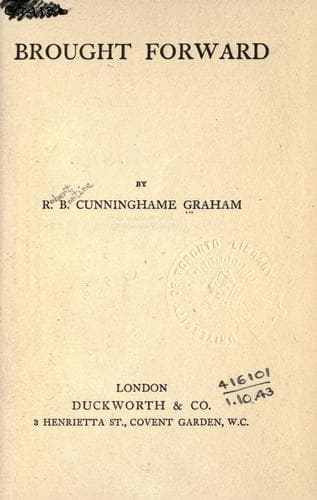
Brought ForwardCunninghame Graham, R. B. (Robert Bontine)
History
Brought Forward
Cunninghame Graham, R. B. (Robert Bontine)
Fiction; Short stories
This done, and having seen the current was slowly bearing down the other
lighter past the sandy beach, with a last hearty curse upon God’s mother
and her Son, whose birth he hinted not obscurely was of the nature of a
mystery, in which he placed no credence, got back into his boat, and went
back to his tug, leaving us all amazed, both at his fluency and faith.
When he had gone and grappled with the other lighter which was slowly
drifting down the stream, two or three men came forward in the lighter
that was already in the little river’s mouth, about a yard or so distant
from the edge, and calling to us to be ready, for the horses had not
eaten for sixteen hours at least, slowly let down the wooden
landing-flap. At first the horses craned their necks and looked out on
the grass, but did not venture to go down the wooden landing-stage; then
a big roan, stepping out gingerly and snorting as he went, adventured,
and when he stood upon the grass, neighed shrilly and then rolled. In a
long string the others followed, the clattering of their unshod feet upon
the wood sounding like distant thunder.
Byrne, the Porteño, stout and high-coloured, dressed in great thigh boots
and baggy breeches, a black silk handkerchief tied loosely round his
neck, a black felt hat upon his head, and a great silver watch-chain,
with a snaffle-bridle in the middle of it, contrasting oddly with his
broad pistol belt, with its old silver dollars for a fastening, came
ashore, carrying his saddle on his back. Then followed Doherty, whose
name, quite unpronounceable to men of Latin race, was softened in their
speech to Duarte, making a good Castilian patronymic of it. He too was a
Porteño, {22} although of Irish stock. Tall, dark, and dressed in
semi-native clothes, he yet, like Byrne, always spoke Spanish when no
foreigners were present, and in his English that softening of the
consonants and broadening of the vowels was discernible that makes the
speech of men such as himself have in it something, as it were,
caressing, strangely at variance with their character. Two or three
peons of the usual Gaucho type came after them, all carrying saddles, and
walking much as an alligator waddles on the sand, or as the Medes whom
Xenophon describes, mincing upon their toes, in order not to blunt the
rowels of their spurs.
Our men, Garcia the innkeeper of Fray Bentos, with Pablo Suarez, whose
negro blood and crispy hair gave him a look as of a Roman emperor of the
degenerate times, with Pancho Arrellano and Miguel Paralelo, the Gaucho
dandy, swaying upon his horse with his toes just touching his heavy
silver stirrups with a crown underneath them, Velez and El Pampita, an
Indian who had been captured young on the south Pampa, were mounted ready
to round the horses up.
They did not want much care, for they were eating ravenously, and all we
had to do was to drive them a few hundred yards away to let the others
land.
Public-domain text, read in full here on John Shaqi.
Reviews
Reviews
No reviews yet
Be the first to share your thoughts on this work.
Join the Discussion
Join the discussion
Sign in to leave a comment or review.
Sign InorCreate an account