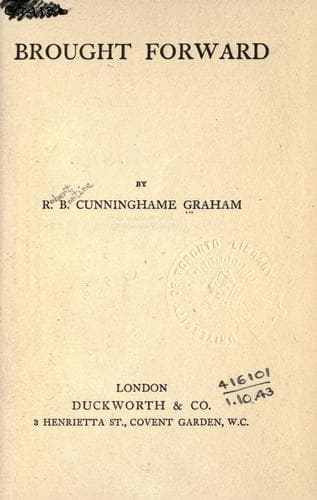
Brought ForwardCunninghame Graham, R. B. (Robert Bontine)
History
Brought Forward
Cunninghame Graham, R. B. (Robert Bontine)
Fiction; Short stories
Clothes are identical, or almost so; the poncho and the loose trousers
stuffed into high patent-leather boots, the hat kept in its place by a
black ribbon with two tassels, are to be seen on both sides of the
frontier. Only in Brazil a sword stuck through the girth replaces the
long knife of Uruguay. Perhaps in that one item all the differences
between the races manifests itself, for the sword is, as it were, a
symbol, for no one ever saw one drawn or used in any way but as an
ornament. It is, in fact, but a survival of old customs, which are
cherished both by the Portuguese and the Brazilians as the apple of the
eye.
The vast extent of the territory of Brazil, its inaccessibility, and the
enormous distances to be travelled from the interior to the coast, and
the sense of remoteness from the outer world, have kept alive a type of
man not to be found in any other country where the Christian faith
prevails. Risings of fanatics still are frequent; one is going on to-day
in Paraná, and that of the celebrated Antonio Concelheiro, twenty years
ago, shook the whole country to its core. Slavery existed in the memory
of people still alive. Women in the remoter towns are still secluded
almost as with the Moors. The men still retain something of the Middle
Ages in their love of show. All in the province of Rio Grande are great
horsemen, and all use silver trappings on a black horse, and all have
horses bitted so as to turn round in the air, just as a hawk turns on the
wing.
The sons of men who have been slaves abound in all the little frontier
towns, and old grey-headed negroes, who have been slaves themselves,
still hang about the great estates. Upon the other side, in Uruguay, the
negro question was solved once and for all in the Independence Wars, for
then the negroes were all formed into battalions by themselves and set in
the forefront of the battle, to die for liberty in a country where they
all were slaves the month before. War turned them into heroes, and sent
them out to die.
When once their independence was assured, the Uruguayans fell into line
like magic with the modern trend of thought. Liberty to them meant
absolute equality, for throughout the land no snob is found to leave a
slug’s trail on the face of man by his subserviency.
Women were held free, that is, as free as it is possible for them to be
in any Latin-peopled land. Across the line, even to-day, a man may stay
a week in a Brazilian country house and never see a woman but a mulata
girl or an old negro crone. Still he feels he is watched by eyes he
never sees, listens to voices singing or laughing, and a sense of mystery
prevails.
Public-domain text, read in full here on John Shaqi.
Reviews
Reviews
No reviews yet
Be the first to share your thoughts on this work.
Join the Discussion
Join the discussion
Sign in to leave a comment or review.
Sign InorCreate an account