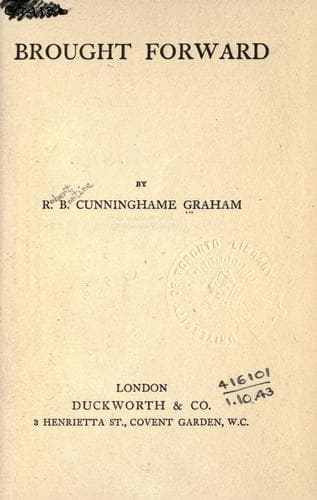
Brought ForwardCunninghame Graham, R. B. (Robert Bontine)
History
Brought Forward
Cunninghame Graham, R. B. (Robert Bontine)
Fiction; Short stories
Spaniards and Portuguese in the New World have blended just as little as
they have done at home. Upon the frontier all the wilder spirits of
Brazil and Uruguay have congregated. There they pursue the life, but
little altered, that their fathers led full fifty years ago. All carry
arms, and use them on small provocation, for if an accident takes place
the frontier shields the slayer, for to pursue him usually entails a
national quarrel, and so the game goes on.
So Jango Chaves, feeling inclined for sport, or, as he might have said,
to “brincar un bocadinho,” saddled up his horse. He mounted, and, as his
friends were looking on, ran it across the plaza of the town, and,
turning like a seagull in its flight, came back to where his friends were
standing, and stopped it with a jerk.
His silver harness jingled, and his heavy spurs, hanging loosely on his
high-heeled boots, clanked like fetters, as his active little horse
bounded into the air and threw the sand up in a shower.
The rider, sitting him like a statue, with the far-off look horsemen of
every land assume when riding a good horse and when they know they are
observed, slackened his hand and let him fall into a little measured
trot, arching his neck and playing with the bit, under which hung a
silver eagle on a hinge. Waving his hand towards his friends, Jango rode
slowly through the town. He passed through sandy streets of flat-roofed,
whitewashed houses, before whose doors stood hobbled horses nodding in
the sun.
He rode past orange gardens, surrounded by brown walls of sun-baked
bricks with the straw sticking in them, just as it had dried. In the
waste the castor-oil bushes formed little jungles, out of which peered
cats, exactly as a tiger peers out of a real jungle in the woods.
The sun poured down, and was reverberated back from the white houses, and
on the great gaunt building, where the captain-general lived, floated the
green-and-yellow flag of the republic, looking like a bandana
handkerchief. He passed the negro rancheria, without which no such town
as Santa Anna do Libramento is complete, and might have marked, had he
not been too much used to see them, the naked negro children playing in
the sand. Possibly, if he marked them, he referred to them as
“cachorrinhos pretos,” for the old leaven of the days of slavery is
strongly rooted in Brazil. So he rode on, a slight and graceful figure,
bending to each movement of his horse, his mobile, olive-coloured
features looking like a bronze masque in the fierce downpour of the sun.
Public-domain text, read in full here on John Shaqi.
Reviews
Reviews
No reviews yet
Be the first to share your thoughts on this work.
Join the Discussion
Join the discussion
Sign in to leave a comment or review.
Sign InorCreate an account