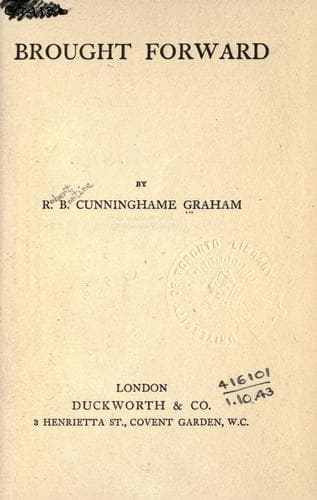
Brought ForwardCunninghame Graham, R. B. (Robert Bontine)
History
Brought Forward
Cunninghame Graham, R. B. (Robert Bontine)
Fiction; Short stories
Discreet applause broke forth, and exclamations such as “wonderful,”
“what grace,” “Vivent les Espagnoles,” for the discriminating audience
took no heed of independence days, of mere political changes and the
like, and seemed to think that Buenos Aires was a part of Spain, never
having heard of San Martin, Bolivar, Paez, and their fellow-liberators.
Paris, London, and New York were to that fashionable crowd the world, and
anything outside—except, of course, the Hungarian gipsies and the Tango
dancers—barbarous and beyond the pale.
After the Tango came “La Maxixe Brésilienne,” rather more languorous and
more befitting to the dwellers in the tropics than was its cousin from
the plains. Again the discreet applause broke out, the audience
murmuring “charming,” that universal adjective that gives an air of being
in a perpetual pastrycook’s when ladies signify delight. Smiles and sly
glances at their friends showed that the dancers’ efforts at indecency
had been appreciated.
Slowly the hall and tea-rooms of the great hotel emptied themselves, and
in the corridors and passages the smell of scent still lingered, just as
stale incense lingers in a church.
Motor-cars took away the ladies and their friends, and drivers, who had
shivered in the cold whilst the crowd inside sweated in the central
heating, exchanged the time of day with the liveried doorkeepers, one of
them asking anxiously, “Dis, Anatole, as-tu vu mes vaches?”
With the soft closing of a well-hung door the last car took its perfumed
freight away, leaving upon the steps a group of men, who remained talking
over, or, as they would say, undressing, all the ladies who had gone.
“Argentine Tango, eh?” I thought, after my friends had left me all alone.
Well, well, it has changed devilishly upon its passage overseas, even
discounting the difference of the setting of the place where first I saw
it danced so many years ago. So, sauntering down, I took a chair far
back upon the terrace of the Café de la Paix, so that the sellers of _La
Patrie_, and the men who have some strange new toy, or views of Paris in
a long album like a broken concertina, should not tread upon my toes.
Over a Porto Blanc and a Brazilian cigarette, lulled by the noise of
Paris and the raucous cries of the street-vendors, I fell into a doze.
Gradually the smell of petrol and of horse-dung, the two most potent
perfumes in our modern life, seemed to be blown away. Dyed heads and
faces scraped till they looked blue as a baboon’s; young men who looked
like girls, with painted faces and with mincing airs; the raddled women,
ragged men, and hags huddled in knitted shawls, lame horses, and taxi-cab
drivers sitting nodding on their boxes—all faded into space, and from the
nothing that is the past arose another scene.
Public-domain text, read in full here on John Shaqi.
Reviews
Reviews
No reviews yet
Be the first to share your thoughts on this work.
Join the Discussion
Join the discussion
Sign in to leave a comment or review.
Sign InorCreate an account