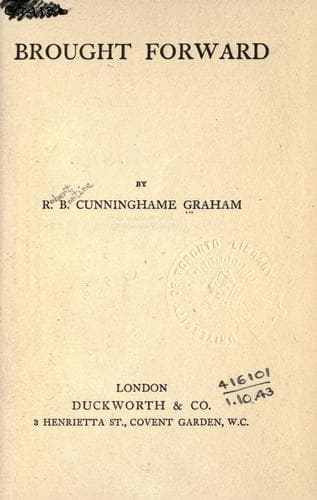
Brought ForwardCunninghame Graham, R. B. (Robert Bontine)
History
Brought Forward
Cunninghame Graham, R. B. (Robert Bontine)
Fiction; Short stories
The Indians, terrified and fearful that Cortes would take revenge upon
them for the death of the horse that he had left for them to care for and
to minister to all his wants, before they buried him, carved a rude
statue in his likeness and placed it in a temple in the lake.
The devil, who, as Villagutierre observes, is never slack to take
advantage when he can, seeing the blindness and the superstition (which
was great) of those abominable idolaters, induced them by degrees to make
a God of the graven image they had made. Their veneration grew with
time, just as bad weeds grow up in corn, as Holy Writ sets forth for our
example, and that abominable statue became the chiefest of their gods,
though they had many others equally horrible.
As the first horses that they saw were ridden by the Spaniards in the
chase of the tame deer, and many shots were fired, the Indians not
unnaturally connected the explosions and the flames less with the rider
than the horse. Thus in the course of years the evolution of the great
god Tziunchan took place, and, as the missionaries said, these heathen
steeped in ignorance adored the work of their own hands.
Father Orbieta, not stopping to reflect that all of us adore what we have
made, but “filled with the spirit of the Lord and carried off with
furious zeal for the honour of our God,” {118} seized a great stone and
in an instant cast the idol down, then with a hammer he broke it into
bits.
When Father Orbieta had finished his work and thus destroyed one of the
most curious monuments of the New World, which ought to have been
preserved as carefully as if it had been carved by Praxiteles, “with the
ineffable and holy joy that filled him, his face shone with a light so
spiritual that it was something to praise God for and to view with
delight.” Most foolish actions usually inspire their perpetrators with
delight, although their faces do not shine with spiritual joy when they
have done them; so when one reads the folly of this muddle-headed friar,
it sets one hoping that several of the stones went home upon his back as
he sat paddling the canoe.
The Indians broke into lamentations, exclaiming, “Death to him, he has
killed our God”; but were prevented from avenging his demise by the
Spanish soldiers who prudently had accompanied the friar.
Thus was the mystery of the eternal Word made manifest amongst the
Maçotecas, and a deity destroyed who for a hundred years and more had
done no harm to any one on earth . . . a thing unusual amongst Gods.
XI
MUDEJAR
BROWN, severe, and wall-girt, the stubborn city still held out.
Its proud traditions made it impossible for Zaragoza to capitulate
without a siege. As in the days of Soult, when the heroic maid, the
_artillera_, as her countrymen call her with pride, when Palafox held up
the blood and orange banner in which float the lions and the castles of
Castille, the city answered shot for shot.
Public-domain text, read in full here on John Shaqi.
Reviews
Reviews
No reviews yet
Be the first to share your thoughts on this work.
Join the Discussion
Join the discussion
Sign in to leave a comment or review.
Sign InorCreate an account