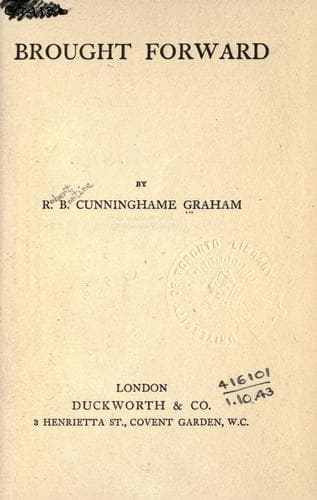
Brought ForwardCunninghame Graham, R. B. (Robert Bontine)
History
Brought Forward
Cunninghame Graham, R. B. (Robert Bontine)
Fiction; Short stories
Fire spurted from the Moorish walls, built by the Beni Hud, who reigned
in Zaragoza, when still Sohail poured its protecting rays upon the land.
The bluish wreaths of smoke curled on the Ebro, running along the water
and enveloping the Coso as if in a mist.
A dropping rifle-fire crackled out from the ramparts, and above the
castle the red flag of the Intransigent-Republic shivered and fluttered
in the breeze.
The Torre-Nueva sprang from the middle of the town, just as a palm tree
rises from the desert sands. It was built at the time when Moorish
artisans, infidel dogs who yet preserved the secrets of the East amongst
the Christians (may dogs defile their graves), had spent their science
and their love upon it.
Octagonal, and looking as if blown into the air by the magician’s art, it
leaned a little to one side, and, as the admiring inhabitants averred,
drawing their right hands open over their left arms, laughed at its rival
of Bologna and at every other tower on earth.
No finer specimen of the art known as Mudejar existed in all Spain.
Galleries cut it here and there; and ajimeces, the little horseshoe
windows divided by a marble pillar, loved of the Moors, which tradition
says they took from the rude openings in their tents of camel’s hair,
gave light to the inside. Stages of inclined planes led to the top, so
gradual in their ascent that once a Queen of Spain had ridden up them to
admire the view over the Sierras upon her palfrey, or her donkey, for all
is one when treating of a queen, who of a certainty ennobles the animal
she deigns to ride upon. Bold ajaracas, the patterns proper to the style
of architecture, stood up in high relief upon its sides, and near the
balustrade upon the top a band of bluish tiles relieved the brownness of
the brickwork and sparkled in the sun. Sieges and time and storms, rain,
wind, and snow had spared it; even the neglect of centuries had left it
unimpaired—erect and elegant as a young Arab maiden carrying water from
the well. Architects said that it inclined a little more each year, and
talked about subsidences; but they were foreigners, unused to the things
of Spain, and no one marked them; and the tower continued to be loved and
prized and to fall into disrepair. On this occasion riflemen lined the
galleries, pouring a hot fire upon the attacking forces of the
Government.
Encamped upon the heights above Torero, the Governmental army held the
banks of the canal that gives an air of Holland to that part of the adust
and calcined landscape of Aragon.
Public-domain text, read in full here on John Shaqi.
Reviews
Reviews
No reviews yet
Be the first to share your thoughts on this work.
Join the Discussion
Join the discussion
Sign in to leave a comment or review.
Sign InorCreate an account