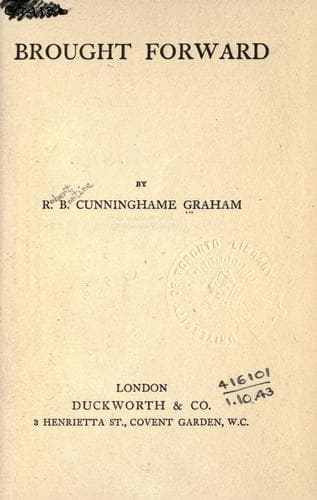
Brought ForwardCunninghame Graham, R. B. (Robert Bontine)
History
Brought Forward
Cunninghame Graham, R. B. (Robert Bontine)
Fiction; Short stories
Rapidly he sketched a state of things in which a happy population, drawn
from the slums, but all instinct with agricultural knowledge, would be
settled on the land, each on his little farm, and all devoted to
intensive culture in the most modern form. Trees would be all cut down,
because they only “’arbour” birds that eat the corn. Hedges would all be
extirpated, for it is known to every one that mice and rats and animals
of every kind live under them, and that they only serve to shelter game.
Each man would own a gun and be at liberty to kill a “rabbut” or a
“’are”—“animals, as we say at college, _feery naturrey_, and placed by
Providence upon the land.”
These noble sentiments evoked applause, which was a little mitigated by
an interjection from a man in gaiters, with a sunburnt face, of: “Mister,
if every one is to have a gun and shoot, ’ow long will these ’ere ’ares
and rabbuts last?”
A little farther on, as thinly covered by his indecently transparent veil
of reciprocity as a bare-footed dancer in her Grecian clothes, or a tall
ostrich under an inch of sand, and yet as confident as either of them
that the essential is concealed, a staunch Protectionist discoursed.
With copious notes, to which he turned at intervals, when he appealed to
those statistics which can be made in any question to fit every side, he
talked of loss of trade. “Friends, we must tax the foreigner. It is
this way, you see, our working classes have to compete with other
nations, all of which enjoy protective duties. I ask you, is it
reasonable that we should let a foreign article come into England?”
Here a dour-looking Scotsman almost spat out the words: “Man, can ye no
juist say Great Britain?” and received a bow and “Certainly, my friend, I
am not here to wound the sentiments of any man . . . as I was saying, is
it reasonable that goods should come to England . . . I mean Great
Britain, duty free, and yet articles we manufacture have to pay heavy
duties in any foreign port?”
“’Ow about bread?” came from a voice upon the outskirts of the crowd.
The speaker reddened, and resumed: “My friend, man doth not live by bread
alone; still, I understand the point. A little dooty upon corn, say five
shillings in the quarter, would not hurt any one. We’ve got to do it.
The foreigner is the enemy. I am a Christian; but yet, readin’ as I
often do the Sermon on the Mount, I never saw we had to lie down in the
dust and let ourselves be trampled on.
“Who are to be the inheritors of the earth? Our Lord says, ‘Blessed are
the meek; they shall inherit it.’”
He paused, and was about to clinch his argument, when a tall Irishman,
after expectorating judiciously upon a vacant space between two
listeners, shot in: “Shure, then, the English are the meekest of the lot,
for they have got the greater part of it.”
Public-domain text, read in full here on John Shaqi.
Reviews
Reviews
No reviews yet
Be the first to share your thoughts on this work.
Join the Discussion
Join the discussion
Sign in to leave a comment or review.
Sign InorCreate an account