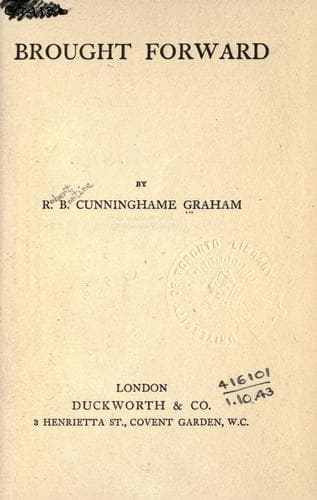
Brought ForwardCunninghame Graham, R. B. (Robert Bontine)
History
Brought Forward
Cunninghame Graham, R. B. (Robert Bontine)
Fiction; Short stories
THE amphitheatre of wood enclosed a bay that ran so far into the land it
seemed a lake. The Uruguay flowed past, but the bay was so land-locked
and so well defended by an island lying at its mouth that the illusion
was complete, and the bay appeared to be cut off from all the world.
Upon the river twice a day passed steamboats, which at night-time gave an
air as of a section of a town that floated past the wilderness. Streams
of electric light from every cabin lit up the yellow, turgid river, and
the notes of a band occasionally floated across the water as the vessel
passed. Sometimes a searchlight falling on a herd of cattle, standing as
is their custom after nightfall upon a little hill, made them stampede
into the darkness, dashing through brushwood or floundering through a
marsh, till they had placed themselves in safety from this new terror of
the night.
Above the bay the ruins of a great building stood. Built scarcely fifty
years ago, and now deserted, the ruins had taken on an air as of a
castle, and from the walls sprang plants, whilst in the deserted
courtyard a tree had grown, amongst whose branches oven-birds had built
their hanging nests of mud. Cypresses towered above the primeval
hard-wood, which grew all gnarled and horny-looking, and nearly all had
kept their Indian names, as ñandubay, chañar, tala and sarandi, molle,
and many another name as crabbed as the trunks which, twisted and
distorted, looked like the limbs of giants growing from the ground.
Orange trees had run wild and shot up all unpruned, and apple trees had
reverted back to crabs. The trunks of all the fruit-trees in the
deserted garden round the ruined factory were rubbed shiny by the cattle,
for all the fences had long been destroyed or fallen into decay.
A group of roofless workmen’s cottages gave an air of desolation to the
valley in which the factory and its dependencies had stood. They too had
been invaded by the powerful sub-tropical plant life, and creepers
covered with bunches of bright flowers climbed up their walls. A
sluggish stream ran through the valley and joined the Uruguay, making a
little natural harbour. In it basked cat-fish, and now and then from off
the banks a tortoise dropped into the water like a stone. Right in the
middle of what once had been the square grew a ceiba tree, covered with
lilac flowers, hanging in clusters like gigantic grapes. Here and there
stood some old ombús, their dark metallic leaves affording an
impenetrable shade. Their gnarled and twisted roots, left half-exposed
by the fierce rains, gave an unearthly, prehistoric look to them that
chimed in well with the deserted air of the whole place. It seemed that
man for once had been subdued, and that victorious nature had resumed her
sway over a region wherein he had endeavoured to intrude, and had been
worsted in the fight.
Public-domain text, read in full here on John Shaqi.
Reviews
Reviews
No reviews yet
Be the first to share your thoughts on this work.
Join the Discussion
Join the discussion
Sign in to leave a comment or review.
Sign InorCreate an account