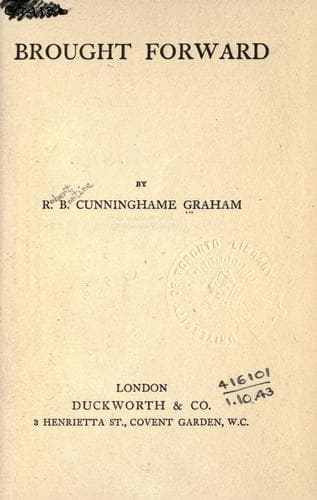
Brought ForwardCunninghame Graham, R. B. (Robert Bontine)
History
Brought Forward
Cunninghame Graham, R. B. (Robert Bontine)
Fiction; Short stories
Nature had so resumed her sway that buildings, planted trees, and paths
long overgrown with grass, seemed to have been decayed for centuries,
although scarce twenty years had passed since they had been deserted and
had fallen into decay.
They seemed to show the power of the recuperative force of the primeval
forest, and to call attention to the fact that man had suffered a defeat.
Only the grass in the deserted square was still triumphant, and grew
short and green, like an oasis in the rough natural grasses that flowed
nearly up to it, in the clearings of the woods.
The triumph of the older forces of the world had been so final and
complete that on the ruins there had grown no moss, but plants and bushes
with great tufts of grass had sprung from them, leaving the stones still
fresh as when the houses were first built. Nature in that part of the
New World enters into no compact with mankind, as she does over here in
Europe to touch his work kindly and almost with a reverent hand, and
blend it into something half compounded of herself. There bread is bread
and wine is wine, with no half-tints to make one body of the whole. The
one remaining evidence of the aggression of mankind, which still refused
to bow the knee to the overwhelming genius of the place, was a round
bunch of eucalyptus trees that stood up stark and unblushing, the colour
of the trunks and leaves so harshly different from all around them that
they looked almost vulgar, if such an epithet can be properly applied to
anything but man. Under their exiguous shade were spread saddles and
bridles, and on the ground sat men smoking and talking, whilst their
staked-out horses fed, fastened to picket-pins by raw-hide ropes. So far
away from everything the place appeared that the group of men looked like
a band of pioneers upon some frontier, to which the ruins only gave an
air of melancholy, but did nothing to dispel the loneliness.
As they sat idly talking, trying to pass, or, as they would have said,
trying to make time, suddenly in the distance the whistle of an
approaching steamer brought the outside world into the little, lonely
paradise. Oddly enough it sounded, in the hot, early morning air,
already heavy with the scent of the mimosas in full bloom. Butterflies
flitted to and fro or soared above the scrub, and now and then a wild
mare whinnied from the thickets, breaking the silence of the lone valley
through which the yellow, little stream ran to the Uruguay.
Catching their horses and rolling up the ropes, the men, who had been
sitting underneath the trees, mounted, and following a little cattle
trail, rode to a high bluff looking down the stream.
Panting and puffing, as she belched out a column of black smoke, some
half a mile away, a tug towing two lighters strove with the yellow flood.
The horsemen stood like statues with their horses’ heads stretched out
above the water thirty feet below.
Public-domain text, read in full here on John Shaqi.
Reviews
Reviews
No reviews yet
Be the first to share your thoughts on this work.
Join the Discussion
Join the discussion
Sign in to leave a comment or review.
Sign InorCreate an account