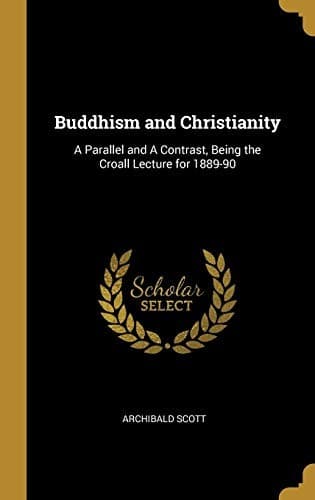
Buddhism and Christianity: A Parallel and a Contrast — John Shaqi
Buddhism and Christianity: A Parallel and a ContrastScott, Archibald
Religion
Buddhism and Christianity: A Parallel and a Contrast
Scott, Archibald
Buddhism -- Relations -- Christianity; Christianity and other religions -- Buddhism
Celsus, quoting our Lord’s saying, Matt. xix. 24, and the exhortation
to forgive our enemies, Matt. v. 43, 45, alleged they were transferred
and coarsely perverted from Plato, _de Legibus_, and _Crito_.—Origen,
_contra Celsum_, Book vi. chaps. 15, 16, and Book vii. chap. 61.
Footnote 60:
_Enarr. in Psalm._ cxl. 6. Clement of Alexandria regarded Greek
philosophy as a προπαιδεία or preparatory discipline for the reception
of Christian truth, _Strom._ vi. chap. 8, and as a step to something
higher, ὑποβάθραν οὖσαν τῆς κατὰ Χριστὸν φιλοσοφίας, _Strom._ vi.
chap. 17.
Footnote 61:
Trench, Hulsean Lectures for 1846, p. 153.
LECTURE II.
THE HISTORICAL ANTECEDENTS OF BUDDHISM AND CHRISTIANITY, AND THE
EVIDENTIAL VALUE OF THEIR RESPECTIVE SCRIPTURES.
It should be an advantage to the study of Buddhism that even in its
origin it confronts us as the religion of a people sufficiently advanced
in civilisation to be able to formulate their metaphysical conceptions
and present us with their religious beliefs organised in a system. Like
Christianity it not only inherited but also produced a considerable and
very miscellaneous literature, whose contents throw valuable light upon
the past from which it emerged and upon the course which it followed,
and like Christianity it has left its stamp on most of the institutions
of the peoples among whom it was successfully propagated. When all these
sources of information have been properly investigated, we may hope that
the story of the rise and progress of Buddhism in the East will be
revealed with something at least of the clearness with which the history
of Christianity is disclosed by the literature and art of the West.
To trace, however, the dawn and spread of Buddhism with anything like
historical accuracy for the first six or seven hundred years of its
course, is a task as yet beyond the literary ability of the times. It is
doubtful whether the materials for such a work have as yet been
collected, and he would be a bold man who would claim for the task of
sifting what has already been furnished more than an earnest beginning.
Not even Saint-Hilaire would now repeat the assertion so confidently
made thirty years ago,[62] that “no new discoveries can change our
conclusions regarding it”; for during the past generation the effect of
fuller information has been not only to modify, but in several instances
to revolutionise the theories formed concerning it. Discoveries are
multiplying every year; and, though the knowledge thus acquired serves
often more to reveal difficulties than to solve them, we may be thankful
that the examination of them is engaging the attention of the highest
order of scholarship, and hopeful, yea, even confident that since so
many of the ablest and most patient minds are turned in this direction,
the aggregate of progress will speedily be immense.
Public-domain text, read in full here on John Shaqi.
Reviews
Reviews
No reviews yet
Be the first to share your thoughts on this work.
Join the Discussion
Join the discussion
Sign in to leave a comment or review.
Sign InorCreate an account