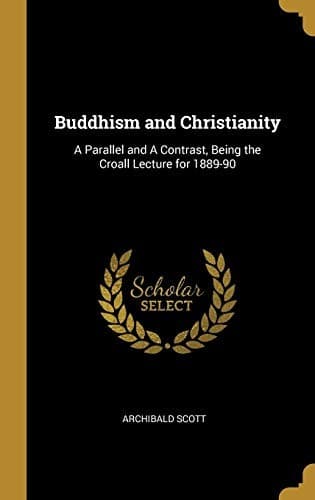
Buddhism and Christianity: A Parallel and a Contrast — John Shaqi
Buddhism and Christianity: A Parallel and a ContrastScott, Archibald
Religion
Buddhism and Christianity: A Parallel and a Contrast
Scott, Archibald
Buddhism -- Relations -- Christianity; Christianity and other religions -- Buddhism
But Christianity from the very earliest possessed what Buddhism for a
long period lacked. In its canonical writings it conserved not only a
check upon this apostasy, but a security for reformation. Mechanical
though it seems, there was a providence in the early committal to
writing of such books as compose our Bibles. In the fact that their
successive disclosures of truth were thus registered there is more
significance than at first appears. It is admitted by all that man’s
progress depends in no small degree on his ability to secure and hand
down the treasures of his wisdom and experience. The art of writing is
thus recognised to be one of the most moving powers in the world. The
nations that have depended upon it for the transmission of knowledge
inherited or acquired, have certainly made more progress in religion and
civilisation than those that have neglected or despised it. It is
significant that the writers of the Bible have all recognised this
condition of human progress, and that many of them have represented
themselves as instructed by the Divine authority, from whom they profess
to have received their communications, to make them permanent in popular
language and in plain written form.[79]
In the history of the Hebrews there is not a single recorded instance of
religious reformation in which the law and the testimony, or the scrolls
of the prophets, did not play an important part. In like manner the New
Testament, which embodies the ideals and perpetuates the standard which
is to regulate its course, not only saved Christianity from the perils
which threatened its earliest spread, but has often rescued it from the
degradation into which it has fallen. Canonical books may only give, as
it has been said, “the reflected image of the real doctrines of the
founder of a religion, an image always blurred and distorted by the
medium through which it has to pass”;[80] but in the case of the New
Testament the Church has never developed, or thought it possible to
develop, a purer reflection. Advance as it may, the Church never can
outgrow the ideals of its youth, and change what it pleases, it never
can improve them. Whenever the Church assumed supremacy over its law,
and whenever tradition superseded its testimony, it yielded to the
disintegrating influences of heathenism. It was rapidly lapsing into
polytheism when Mohammed rose with a spurious and mutilated version of
the Scriptures to recall it to the witness of true Scriptures to the
unity and sovereignty of God. Later on, when sinking through formalism
into superstition and sorcery almost as degrading as any Indian, Luther,
by the re-discovery of the Greek Testament, brought about a reformation
which not only saved Europe, but has created a new Western and Southern
world. In every revival and every advance which has taken place since
then there may be traced, directly or indirectly, the regenerative
influences of the Christian originals. On its human side the Christian
Public-domain text, read in full here on John Shaqi.
Reviews
Reviews
No reviews yet
Be the first to share your thoughts on this work.
Join the Discussion
Join the discussion
Sign in to leave a comment or review.
Sign InorCreate an account