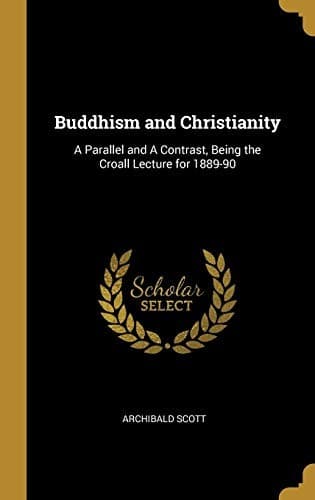
Buddhism and Christianity: A Parallel and a ContrastScott, Archibald
Religion
Buddhism and Christianity: A Parallel and a Contrast
Scott, Archibald
Buddhism -- Relations -- Christianity; Christianity and other religions -- Buddhism
For the want of an authoritative standard told very severely against the
early history of Buddhism. Its rapid and widespread extension was due,
not so much to the natural development of its own principles as to its
assimilation of the external and foreign influences with which it came
in contact. Its advance was the result more of compromise than of
conquest.[78] It welcomed or tolerated, at least it could not or did not
defend itself against the introduction of many parasitical germs which
were destined to arrest its growth and pass into its life. As the ivy
covers and adorns the oak only to suck away with its million mouths its
strength, so the popular beliefs which Buddhism incorporated from
without, as well as the defections from the original teaching which took
place within it, produced very soon upon it alterations so extensive
that its founder would have disclaimed or would have been really unable
to recognise it as his own.
No temptation happened to Buddhism, however, but such as is common to
all the higher religions. As far as observation and experience go, the
lower types of religion continue unchanged; but those that confront us
upon a higher level are in a perpetual flux, in which change does not
always indicate progress. Instead of tracing their path by the
superstitions which they have outgrown, their course may be indicated by
those which they have incorporated. Man, in his exodus of faith, is
always tempted to go back to the condition from which he has emerged, or
to fall away to the religions by which he is surrounded. Mosaism and
Christianity had to pass through this trial, and certainly they did not
pass through it unscathed. They suffered from the corruption of popular
superstitions and of Pagan rites, all of which, as in the case of
Buddhism, were defended by an appeal to tradition. Just as every
Buddhist innovator was ready with some forgotten saying or Sutta alleged
to have been delivered by the “Blessed One,” sometimes miraculously
preserved through the ages till the necessity for the revelation arose,
so the Popes and the Fathers of Christendom were never at a loss for
authorities when, professing to develop and define, they in reality were
adding to the faith and the worship and the claims of the Church.
Public-domain text, read in full here on John Shaqi.
Reviews
Reviews
No reviews yet
Be the first to share your thoughts on this work.
Join the Discussion
Join the discussion
Sign in to leave a comment or review.
Sign InorCreate an account