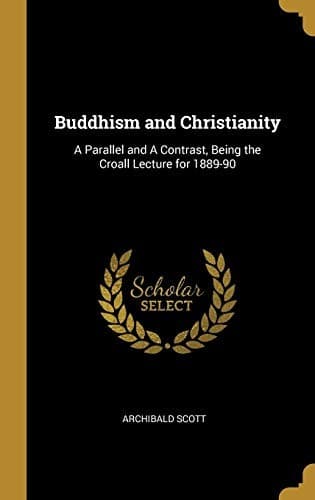
Buddhism and Christianity: A Parallel and a Contrast — John Shaqi
Buddhism and Christianity: A Parallel and a ContrastScott, Archibald
Religion
Buddhism and Christianity: A Parallel and a Contrast
Scott, Archibald
Buddhism -- Relations -- Christianity; Christianity and other religions -- Buddhism
The comparative study of other religions, so far from being prejudicial
to the claims of Christianity, will be helpful in establishing its
sublime pre-eminence among them, and in enabling us to discharge to
their adherents the duty which its Founder has imposed upon us. It may
modify considerably our theology, but it will strengthen our fundamental
beliefs. As a general rule, we may assert that the strength of a man’s
faith will be found to be in direct proportion to his knowledge of the
everlasting and unchangeable laws by which the universe is governed. It
is our theology alone that is assailed, and we are learning that
theology, as a system of reasoning upon materials furnished not only by
religion itself, but also by some other “ologies,” must be based on
other and higher authority than that of an infallible Council, or that
of a chapter whose significance was supposed to be unalterably fixed two
or three thousand years ago. The religion which revolted against the
assumption of the Scribe in our Lord’s day, and which disallowed the
claim of the Pope some three centuries ago to be the sole interpreters
of revelation, is not only testing the authenticity of the texts to
which the appeal was then made, but is inquiring into their actual
significance by collating them with the truths of another revelation as
divine. It is not that men want to get rid of dogma, for dogma of some
kind there must ever be. There will always be a vast deal which we must
believe, because there is much that can only thus be known; but a
satisfactory dogmatic foundation must henceforth be sought in facts
anterior to any scriptures, or to any church that would interpret them,
viz., in the elemental necessities and aspirations of our common human
nature. It has been wisely said that “the theology which fails to meet
the demands of the whole man is simply doomed.”[6] What is wanted
therefore for theology is some broad and solid basis, to be laid by
analysing, comparing, and co-ordinating all religious beliefs within our
reach. In each of them we may hope to find some truth—it may be very
feebly and very partially expressed—of no more value by itself than a
flake of gold found in an immense drift of sand or mass of quartz, but
yet of immense value as indicating the source from which it came and the
substance to which it claims affinity. All separate and imperfect truths
point towards some higher truth which will unite and fulfil and
interpret them. And so every religion, however erroneous it may be, is
prophetic—because found in a humanity that is essentially one—of a
universal religion, a faith which is not just one of the faiths of the
nations, but is the divine answer, unchanged and inexhaustible, to all
the aspirations of mankind. The study of other religions therefore, even
of those of the most degraded peoples, and of those most contradictory
of our own, is as binding upon us as is the study of our Bibles. For us
Public-domain text, read in full here on John Shaqi.
Reviews
Reviews
No reviews yet
Be the first to share your thoughts on this work.
Join the Discussion
Join the discussion
Sign in to leave a comment or review.
Sign InorCreate an account