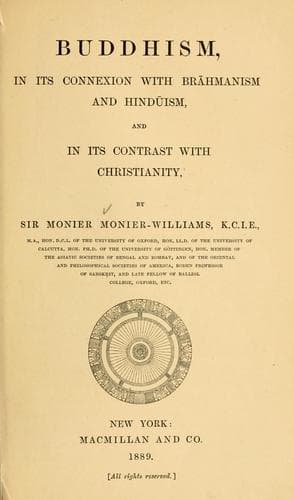
Buddhism, in Its Connexion with Brahmanism and Hinduism, and in Its Contrast with ChristianityMonier-Williams, Monier, Sir
Religion
Buddhism, in Its Connexion with Brahmanism and Hinduism, and in Its Contrast with Christianity
Monier-Williams, Monier, Sir
Buddhism; Buddhism -- Relations -- Christianity; Christianity and other religions -- Buddhism; India -- Religion
It does not appear, in short, that the preachers of either Buddhism, or
Vaishṇavism, or Ṡaivism, or Ṡāktism, or of any form of these sectarian
systems, ever incurred the special animosity of the Brāhmans or of each
other, or ever indulged in very violent denunciations of each other’s
religious doctrines.
In real truth, these systems of doctrine were all evolved out of
Brāhmanism. They were, therefore, not only tolerated by Brāhmanism, but
accepted as the inevitable outcome of its own pantheistic creed.
No doubt each received at first a strong stamp of individuality from its
founder, marking it off from other systems, but with the lapse of years
the deeper shades of difference grew fainter. Then it became a question
which should become merged in the other. In such a competition between
rival systems Buddhism had less chance of holding its own than either
Vaishṇavism or Ṡaivism; for its root-ideas—as we have seen—were not
rooted in the eternal instincts of human nature.
Buddhism, in fact, could never have maintained itself in India till the
twelfth or thirteenth century of our era, had it not gradually, and to a
great extent through interaction with Vaishṇavism and Ṡaivism, dropped
its unnatural pessimistic theory of life and its unpopular atheistic
character, and accommodated itself to those systems.
But Buddhism in parting with its ultra-pessimism and its atheistic and
agnostic ideas, lost its chief elements of individuality and its chief
independent stand-point.
Vaishṇavism, on the other hand, was quite alive to its own interests,
and had an eye to the spread of its own doctrines. It took care to adopt
all the popular features of Buddhism. It vied with Buddhism in
inculcating universal love, toleration, liberality, benevolence, and
abstinence from injury. It preached equality, fraternity, and even in
some cases the abolition of caste distinctions. It taught a succession
of incarnations or rather descents (Avatāra[71]) of divine beings upon
earth (as Buddhism taught a succession of Buddhas), and it even adopted
the Buddha himself as one of the incarnations of Vishṇu.
This, indeed, is the best explanation of what has happened at Purī in
Orissa, where a temple once dedicated to Gautama Buddha, and supposed to
contain a relic of his burnt body, was afterwards dedicated to the
Jagannāth form of Kṛishṇa and supposed to enshrine one of his bones, and
where low-caste and high-caste both eat together the food cooked in the
house of that popular god.
Public-domain text, read in full here on John Shaqi.
Reviews
Reviews
No reviews yet
Be the first to share your thoughts on this work.
Elsewhere in the archive
Join the Discussion
Join the discussion
Sign in to leave a comment or review.
Sign InorCreate an account