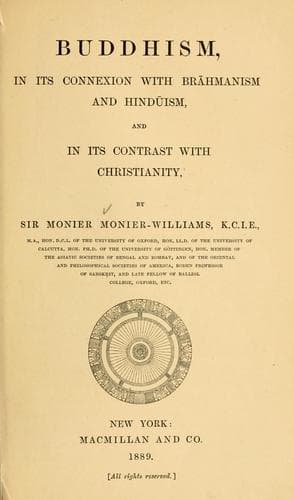
Buddhism, in Its Connexion with Brahmanism and Hinduism, and in Its Contrast with ChristianityMonier-Williams, Monier, Sir
Religion
Buddhism, in Its Connexion with Brahmanism and Hinduism, and in Its Contrast with Christianity
Monier-Williams, Monier, Sir
Buddhism; Buddhism -- Relations -- Christianity; Christianity and other religions -- Buddhism; India -- Religion
The same may be said of the interaction which took place between
Buddhism and Ṡaivism; for Ṡaivism, of course, was quite as bent on the
propagation of its own creed as other systems were. It vied with
Buddhism in encouraging abstract meditation, and although it had less
sympathy than Vaishṇavism had with that system, it approached in some
respects so closely to its rival, that when Buddhism disappeared from
India, images of Gautama were converted into representations of Ṡiva
seated in profound contemplation.
Ultimately, the interaction between the three systems proceeded to such
a point that each was influenced and modified by the other; each learnt
something, or adopted some practice from the other.
It was thus, too, that Ṡāktism, i. e. the worship of energy or force
(Ṡakti), identified with Ṡiva’s consort, was imported into Buddhism; its
doctrine of the self-evolution of all things from Prakṛiti having much
that harmonized with the Buddhist theory of the origin of the Universe.
Thus, too, even Tāntrism in its worst forms became intermixed with
Buddhistic practice.
Enough, then, has been said to justify the assertion that Buddhism was
not forcibly expelled from India by the Brāhmans. It simply in the
end—possibly as late as the thirteenth century of our era—became blended
with the systems which surrounded it, though the process of blending was
gradual.
It would certainly be easy to prove from the records of the three
Chinese travellers, that Buddhism and Brāhmanism existed together in
Northern and Central India as quite distinct systems till at least the
seventh century of our era, if not always quite amicably, yet without
any violent internecine conflict. Bitter controversies between the two
rival creeds are without doubt clearly alluded to, and Fā-hien in one
passage states that ‘the Brāhmans with their contrary doctrine became
full of hatred and envy in their hearts[72].’ Yet, on the other hand, we
find that at a Council held by the great Buddhist king Ṡilāditya
(Harsha-vardhana), whose meritorious acts are fully described by Hiouen
Thsang (ch. v), and who had his capital at Kanouj, in the year 634 of
our era[73], controversial points relating to both Buddhism and
Brāhmanism were discussed in a tolerant spirit, though it is said that
in discussing questions between the Northern and Southern Buddhists, the
‘Little Vehicle’ was condemned.
Again, the Buddhist drama called Nāgānanda, ‘joy of the snake
world[74],’ throws great light on the amicable relations existing
between the various sectarians and religionists in the days of king
Ṡilāditya. It is the only Sanskṛit play in which the Nāndī or opening
prayer invokes the power of Buddha, thus:—
Public-domain text, read in full here on John Shaqi.
Reviews
Reviews
No reviews yet
Be the first to share your thoughts on this work.
Elsewhere in the archive
Join the Discussion
Join the discussion
Sign in to leave a comment or review.
Sign InorCreate an account