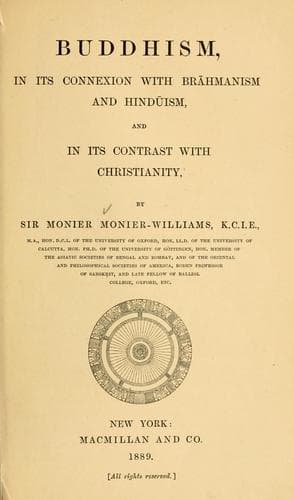
Buddhism, in Its Connexion with Brahmanism and Hinduism, and in Its Contrast with ChristianityMonier-Williams, Monier, Sir
Religion
Buddhism, in Its Connexion with Brahmanism and Hinduism, and in Its Contrast with Christianity
Monier-Williams, Monier, Sir
Buddhism; Buddhism -- Relations -- Christianity; Christianity and other religions -- Buddhism; India -- Religion
It seems, therefore, only natural that the followers of Buddha, and
probably the Buddha himself, before his decease, should have thought it
desirable to establish a more systematic gradation of saintship by
filling up the immense gap between ordinary Arhats and the supreme
Buddha. It was this that led to the idea of Pratyeka-Buddhas, that is,
self-dependent solitary Buddhas[89] (see p. 134), as well as to the
notion of a still higher being called a Bodhi-sattva, who, as the
Buddha-designate and future successor of Gautama, occupied a still more
exalted intermediate position than a Pratyeka-Buddha.
Of course it became difficult to fix on any living man, or any recently
deceased saint worthy of the highest stage of Bodhi, to which a being
about to become a perfect Buddha was supposed to attain.
The first to be so elevated (though apparently not by Gautama himself)
was, as frequently mentioned before, the mythical individual Maitreya.
He was, we repeat, for a long time the only Bodhi-sattva recognized by
all Buddhists alike, whether adherents of the Hīna-yāna or Mahā-yāna.
But he was not a historical personage, like Gautama or his immediate
disciples. He was a mere mythological personification of that spirit of
love—of that kindly and friendly disposition towards all living beings
by force of which Buddhism hoped one day to conquer the world, and win
it over to itself.
And in conformity with his mythical character, and probably to prevent
the rivalry of pretenders among future ambitious heads of monasteries,
he was not to appear for five thousand years, till the teaching of
Gautama had lost its power.
Indeed, it was only to be expected that this rank should at first have
been accorded to one person alone—just as in worldly affairs there could
be only one Heir-apparent to the throne.
Such was the more simple doctrine of early Buddhism in regard to the
relative position of the members of the Buddhist community.
How then did the teachers of the Mahā-yāna proceed to amplify this
doctrine?
They taught that there were two methods of salvation or, so to speak,
two ways or two vehicles—the Great and the Little (Mahā-yāna and
Hīna-yāna)—and indeed two Bodhis or forms of true knowledge which these
vehicles had to convey[90]. The former was for ordinary persons, the
latter for beings of larger talents and higher spiritual powers. The
‘Little Way’ was the simple doctrine, which had many Arhats but only one
Bodhi-sattva; the ‘Great Way,’ on the other hand, was the wider and
broader, which had many Bodhi-sattvas as well as many Arhats. He who
satisfied the usual requirements of Saintship received the rank of an
Arhat in both systems. But in the wider system every one who aimed at
unusual sanctity on the one hand, and knowledge (Bodhi) on the other,
might walk on the Great road leading to Bodhi-sattvaship, and receive
the title Bodhi-sattva.
Public-domain text, read in full here on John Shaqi.
Reviews
Reviews
No reviews yet
Be the first to share your thoughts on this work.
Elsewhere in the archive
Join the Discussion
Join the discussion
Sign in to leave a comment or review.
Sign InorCreate an account