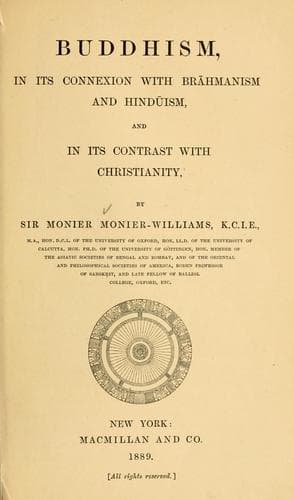
Buddhism, in Its Connexion with Brahmanism and Hinduism, and in Its Contrast with ChristianityMonier-Williams, Monier, Sir
Religion
Buddhism, in Its Connexion with Brahmanism and Hinduism, and in Its Contrast with Christianity
Monier-Williams, Monier, Sir
Buddhism; Buddhism -- Relations -- Christianity; Christianity and other religions -- Buddhism; India -- Religion
We have seen (p. 136) that the Hīna-yāna, or ‘Little system,’ taught
that there were only twenty-four Buddhas who had preceded Gautama. Three
of these (viz. Kraku-ććhanda, Kanaka-muni, and Kāṡyapa), with Gautama as
a fourth, had appeared in the present age, and only one Bodhi-sattva
(Maitreya) was to come.
But according to the ‘Great System,’ it was a mistake to limit the
acquisition of the highest Saintship in this manner. It maintained that
there would be numberless supreme Buddhas (and, in addition to them,
self-taught, solitary Buddhas, called Pratyeka-Buddhas), as well as
numberless Bodhi-sattvas, even in the present age of the world. In other
words, it propounded the doctrine that the practice of the six (or ten)
transcendent virtues (p. 128), and especially the acquisition of
transcendent wisdom (prajñā pāramitā), might qualify many saints for the
attainment of Bodhi-sattvaship and Buddhaship. According to one theory,
there were to be at least a thousand Bodhi-sattvas, followed by a
thousand Buddhas, while, according to others, Buddhas and Bodhi-sattvas
were to be reckoned by myriads.
But this theory of numberless Bodhi-sattvas involved an entirely new
view of their nature and of the meaning of the term.
In fact, the Bodhi-sattvas of the more developed Mahā-yāna school were
not Bodhi-sattvas at all, according to the strict sense of the term. It
is true they resembled the genuine Bodhi-sattva in having gone through a
long series of existences leading them at last to perfect saintship and
to a heaven of their own, but they were under no obligation to give up
their Bodhi-sattvaship, quit their celestial abodes, or descend
ultimately as human Buddhas upon earth.
Furthermore, they never appeared to aim at Pari-nirvāṇa like their
earthly counterparts. Their most obvious _raison d’être_ seems to have
been to supply the need of personal objects of worship, and though in
Tibet they were believed to have their own secondary corporeal
emanations—sometimes called their ‘incarnations,’ but more properly
described as descents (avatāra) of portions of their essence in a
constant succession of human saints,—they never really left their own
permanent stations in the heavenly regions. Indeed, it is probable that
the chief cause of their popularity, as personal objects of adoration,
was that they were able to help their worshippers to attain to the same
permanent and unchangeable regions of bliss.
Public-domain text, read in full here on John Shaqi.
Reviews
Reviews
No reviews yet
Be the first to share your thoughts on this work.
Elsewhere in the archive
Join the Discussion
Join the discussion
Sign in to leave a comment or review.
Sign InorCreate an account