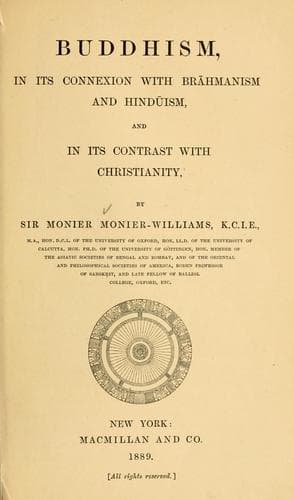
Buddhism, in Its Connexion with Brahmanism and Hinduism, and in Its Contrast with ChristianityMonier-Williams, Monier, Sir
Religion
Buddhism, in Its Connexion with Brahmanism and Hinduism, and in Its Contrast with Christianity
Monier-Williams, Monier, Sir
Buddhism; Buddhism -- Relations -- Christianity; Christianity and other religions -- Buddhism; India -- Religion
It was thus that the ‘Great Vehicle’ took up an attitude which raised it
not only above the simple effort to suppress the passions and desires,
but also above the hopeless Nihilism of early Buddhism; for it soon
became the fashion for the most devoted and pious of Buddhist monks to
aspire to the title and actual blessedness of Bodhi-sattvaship rather
than to the doubtful blessedness of utter personal annihilation involved
in Buddhahood. At any rate the numerous Bodhi-sattvas of the ‘Great
Method’ appear to have remained quite contented with their condition, so
long as it involved perpetual residence in the heavens, and quite
willing to put off all desire for Buddhahood and Pari-nirvāṇa.
Without doubt, this more amplified system was the result of a reaction
of Brāhmanism on Buddhism. It was at first a mere plan for creating a
close Hierarchy like that of the Brāhman caste—that is to say, a
privileged class of men possessed of higher knowledge and sanctity and
superior to the majority of Bhikshus of the common stamp. Then it soon
developed into a scheme for satisfying the craving of the masses for
divinities of some kind to whom they might appeal for help in time of
need.
In all probability the first to receive the title of Bodhi-sattva, next
to Maitreya, were the most celebrated Arhats before mentioned, who were
immediate disciples of Gautama, not however till death had separated
them from their human frames, when, as a matter of course, they received
a kind of worship like that accorded to all leaders of men, just as the
earliest saints, heroes, and teachers of Brāhmanism did.
To specify all the Arhats who were elevated to the rank of Bodhi-sattva
and became objects of veneration in later times would be a difficult and
unprofitable task.
We may also dismiss, as unworthy of note, statements such as that in the
Lalita-vistara, in which it is declared that 32,000 Bodhi-sattvas joined
the Buddha’s assembly in the Jetavana garden. But we may notice the
quasi-deification of a few historical personages mentioned by the two
Chinese travellers, whose account of the state of Buddhism in India from
the fourth to the seventh centuries has been so often quoted.
First of all came the immediate followers and so-called ‘great pupils’
(see p. 47) of Gautama, namely, his two chief disciples, Ṡāri-puttra and
Moggallāna (Maudgalyāyana = Modgala-puttra)[91], both of whom are
believed to have died before him. Then came the three great leaders at
the first Council: 1. Kāṡyapa (pp. 46, 55); 2. Gautama’s cousin and
beloved pupil Ānanda; 3. Upāli (note, p. 56).
Public-domain text, read in full here on John Shaqi.
Reviews
Reviews
No reviews yet
Be the first to share your thoughts on this work.
Elsewhere in the archive
Join the Discussion
Join the discussion
Sign in to leave a comment or review.
Sign InorCreate an account