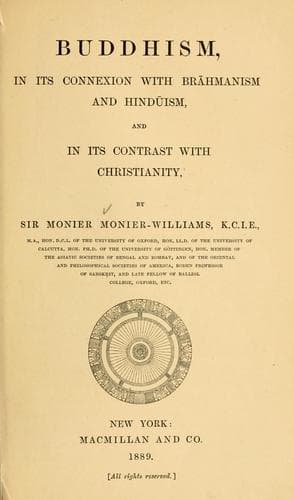
Buddhism, in Its Connexion with Brahmanism and Hinduism, and in Its Contrast with ChristianityMonier-Williams, Monier, Sir
Religion
Buddhism, in Its Connexion with Brahmanism and Hinduism, and in Its Contrast with Christianity
Monier-Williams, Monier, Sir
Buddhism; Buddhism -- Relations -- Christianity; Christianity and other religions -- Buddhism; India -- Religion
Next to these perhaps the most celebrated teacher elevated to
Bodhi-sattvaship was Nāgārjuna[92]—noticed before as the alleged founder
of the Mahā-yāna system and its introducer into Tibet. According to one
account he was the son of a Brāhman of Vidarbha, and taught Buddhism in
the south of India. He had a celebrated disciple named Deva (or
Ārya-deva)[93]. Nāgārjuna was at any rate a great teacher and developer
of the Mahā-yāna. A legend relates that he was skilled in magic, and was
able thereby to prolong his own and a Southern Indian king’s life
indefinitely. This caused great grief to the mother of the
Heir-apparent, who instigated her son to ask Nāgārjuna for his own head.
Nāgārjuna complied with the request, and cut his own head off with a
blade of Kuṡa grass, nothing else having the power to injure him. He is
said by Hiouen Thsang to have lived in Southern Koṡala about 400 years
after the death of Gautama, and is worshipped under different epithets
in Tibet, China, Mongolia, and even Ceylon. Probably he lived in the
first or second century—Beal places him between A.D. 166 and 200.
Wassiljew considers him a wholly mythical personage. The additions he
made to Buddhist doctrines were undoubtedly great. When he died Stūpas
were erected to his memory, and in some places he was even worshipped as
Buddha.
Among other deified, or partially deified Bodhi-sattvas, whose images
and Stūpas (p. 161) the Chinese pilgrims found scattered in various
parts of India, may be mentioned, those of the mythical Buddhas who
preceded Gautama, especially Kāṡyapa[94]. Then we have Rāhula (son of
Gautama), the patron of all novices, and founder of the realistic school
called Vaibhāshika[95]; Dharma-pāla, Vasu-mitra (or Vasu-bandhu),
Aṡva-ghosha, Guṇamati, Sthiramati, and others. In this practice of
deifying their saints, Buddhists merely followed the example of the
adherents of Hindūism. And we may add that this tendency is constantly
repeating itself in the religious history of all nations.
There is even a tendency to press the saints of other countries into the
service. This is remarkably exemplified in the history of Barlaam and
Josaphat, current in Europe in the Middle Ages. The zealous Roman
Catholics of those days thought that they could not exclude so noble a
monk as Buddha from the catalogue of their own saints, and so they
registered him in their list as St. Josaphat (Josaphat being a
corruption of Bodhisat). Colonel Yule, in his Marco Polo, states that a
church in Palermo is dedicated to this saint.
Public-domain text, read in full here on John Shaqi.
Reviews
Reviews
No reviews yet
Be the first to share your thoughts on this work.
Elsewhere in the archive
Join the Discussion
Join the discussion
Sign in to leave a comment or review.
Sign InorCreate an account