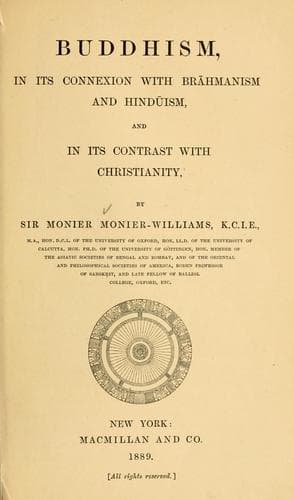
Buddhism, in Its Connexion with Brahmanism and Hinduism, and in Its Contrast with ChristianityMonier-Williams, Monier, Sir
Religion
Buddhism, in Its Connexion with Brahmanism and Hinduism, and in Its Contrast with Christianity
Monier-Williams, Monier, Sir
Buddhism; Buddhism -- Relations -- Christianity; Christianity and other religions -- Buddhism; India -- Religion
A well-known instance of suspended animation occurred in the Panjāb in
1837. A Hindū Yogī was there, by his own request, buried alive in a
vault for forty days in the presence of Runjit Singh and Sir Claude
Wade; his eyes, ears, and every orifice of his body having been first
stopped with plugs of wax. Dr. McGregor, the then residency surgeon,
also watched the case. Every precaution was taken to prevent deception.
English officials saw the man buried, as well as exhumed, and a
perpetual guard over the vault was kept night and day by order of Runjit
Singh himself. At the end of forty days the disinterment took place. The
body was dried up like a stick, and the tongue, which had been turned
back into the throat, had become like a piece of horn. Those who exhumed
him followed his previously-given directions for the restoration of
animation, and the Yogī told them he had only been conscious of a kind
of ecstatic bliss in the society of other Yogīs and saints, and was
quite ready to be buried over again.
What amount of fraud there may be in these feats it is difficult to say.
They may possibly be accounted for by the fact that Indian Yogīs have
studied the habits of hibernating animals; but in some cases the secret
introduction of food has been detected.
I may add that it is commonly believed throughout India that a man whose
body is sublimated by intense abstract meditation never dies, in the
sense of undergoing corruption and dissolution. When his supposed death
occurs he is held to be in a state of trance, which may last for
centuries, and his body is, therefore, not burnt, but buried—generally
in a sitting posture—and his tomb is called a Samādh.
With regard to the fifth requisite—the act of withdrawing the senses
from their object, as, for example, the eye from visible forms—this is
well compared to the act of a tortoise withdrawing its limbs under its
shell.
The sixth requisite—fixing the principle of thought—comprises the act of
directing the thinking faculty (ćitta) towards various parts of the
body, for example, towards the heart, or towards the crown of the head,
or concentrating the will-force on the region between the two eyebrows,
or even fixing the eyes intently on the tip of the nose. (Compare
Bhagavad-gītā VI. 13.)
Public-domain text, read in full here on John Shaqi.
Reviews
Reviews
No reviews yet
Be the first to share your thoughts on this work.
Elsewhere in the archive
Join the Discussion
Join the discussion
Sign in to leave a comment or review.
Sign InorCreate an account