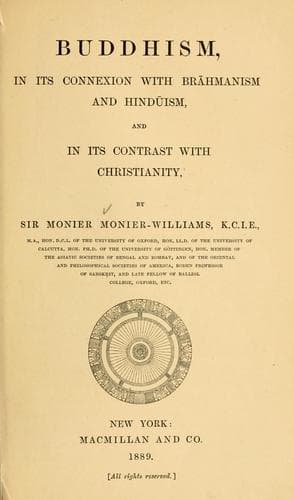
Buddhism, in Its Connexion with Brahmanism and Hinduism, and in Its Contrast with ChristianityMonier-Williams, Monier, Sir
Religion
Buddhism, in Its Connexion with Brahmanism and Hinduism, and in Its Contrast with Christianity
Monier-Williams, Monier, Sir
Buddhism; Buddhism -- Relations -- Christianity; Christianity and other religions -- Buddhism; India -- Religion
I witnessed part of a dramatic performance at a Burmese Theatre in
Calcutta (during the Exhibition year), when the story of the Hindū Epic,
called Rāmāyaṇa, and especially that portion of it which relates to the
carrying off of Sītā by demons (see ‘Brāhmanism and Hindūism,’ p. 42,
and ‘Indian Wisdom,’ p. 337), was dramatically represented. The theatre
was a rude wooden enclosure open to the sky, with the exception of a
portion roofed over for a band of musicians, whose noisy performances
appeared to constitute an important element in the proceedings. The
chief musician sat on the ground in the middle of a circular
frame-work—about two or three feet high—hung round with drums of
different sizes, which he struck with his hands, and occasionally tuned
by the application of moist clay in larger or smaller lumps. In the
centre of the open area of flat dusty soil which served for the stage, a
big branch of a tree was stuck upright, possibly to represent the forest
in which Rāma lived with his wife. Then the hero and heroine of the
drama—Rāma and Sītā—kept up a tedious colloquy, interspersed with jokes,
for hours. The former—who, be it remembered, was supposed to be a
god—smoked a cigar all the while, and occasionally ejected saliva with
perfect indifference to all appearances and to all laws of congruity,
while every now and again Sītā, in spite of a tight dress, varied the
monotony of the dialogue by executing a slow dance, characterized by
strange contortions, twistings, and wrigglings of the limbs. Hideous
masks were at intervals assumed by the actors, and, of course, by the
demons who intervened at odd moments with much ludicrous gesticulation.
The action of the play went on continuously for about ten days, during
which period people came and went as they liked, and the last comers
entered into the progress of the plot with as much interest as if they
had witnessed the whole. There is never much originality of invention in
these religious plays. The Indian heroic poems and the five hundred and
fifty birth-stories (see p. 63) of the Buddha furnish the basis of all.
The religious dramas of Tibet are of a somewhat different character. The
following description is founded on Dr. Schlagintweit’s account (p.
233), and on that of Mrs. Bridges in her interesting ‘Travels’ (John
Murray, 1883, p. 130).
Public-domain text, read in full here on John Shaqi.
Reviews
Reviews
No reviews yet
Be the first to share your thoughts on this work.
Elsewhere in the archive
Join the Discussion
Join the discussion
Sign in to leave a comment or review.
Sign InorCreate an account