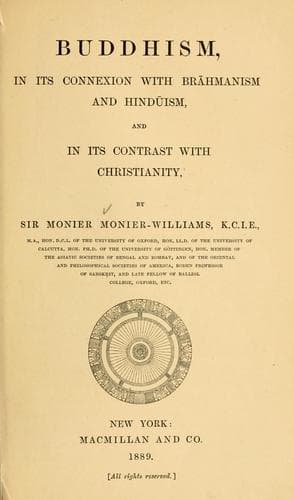
Buddhism, in Its Connexion with Brahmanism and Hinduism, and in Its Contrast with ChristianityMonier-Williams, Monier, Sir
Religion
Buddhism, in Its Connexion with Brahmanism and Hinduism, and in Its Contrast with Christianity
Monier-Williams, Monier, Sir
Buddhism; Buddhism -- Relations -- Christianity; Christianity and other religions -- Buddhism; India -- Religion
An old man who was in charge of the ruins when we examined them, lighted
a candle, and took us into the horizontal tunnel-like gallery which the
General had excavated some years before, in the hope that relics or
memorials of some kind might be found buried in the interior. A shaft or
well had been previously sunk from the summit, and at the depth of 10½
feet a slab was discovered, inscribed with the well-known Buddhist
formula ‘Ye dharmā,’ etc. (p. 104); but the search for relics proved
unsuccessful. The Stūpa, in fact, turned out to be merely memorial, like
that at Buddha-Gayā.
Probably some monumental Stūpa existed here from the earliest times, and
certainly from Aṡoka’s time. The present Stūpa was seen by Hiouen
Thsang, who has described it in rather a confused manner (Beal, ii. 45).
Hence it must be as old as about the ninth century. Fā-hien saw a Stūpa
of some kind there in the fifth century (p. 387).
About fifty yards from the Stūpa, Sir A. Cunningham found the
interesting sculpture given at p. 477.
_Rāja-gṛiha._
Rāja-gṛiha (Pāli, Rāja-gaha) is the modern Rāj-gīr. The old city had the
epithet Giri-vraja, ‘surrounded by hills[201].’ It was the first
metropolis or mother-city of Buddhism, and the original capital of the
powerful kingdom of Magadha, when under the rule of the Kings Bimbi-sāra
(p. 48) and his son Ajāta-ṡatru, who were contemporaries and friends of
Gautama, and converted by him to Buddhism[202]. The sacred character of
the place is attested by the ruins of vast numbers of Buddhist Stūpas
and Vihāras which once existed here. Unhappily Brāhmans and Musalmāns
have used the materials for their temples, tombs, and mosques.
It was here that Gautama first studied under the Brāhmans Āḷāra and
Uddaka (p. 29), and here he first imbibed the philosophical ideas which
afterwards coloured his teaching. It is not surprising, therefore, that
at a later period of his career he was fond of returning to Rāja-gṛiha
for retirement during Vassa; his two favourite resorts[203] being the
Bambu grove (Veḷu-vana, p. 48) and the hill called Vulture-peak
(Gṛidhra-kūṭa, Legge’s Fā-hien, 81, 83), both in the neighbourhood of
the city.
Public-domain text, read in full here on John Shaqi.
Reviews
Reviews
No reviews yet
Be the first to share your thoughts on this work.
Elsewhere in the archive
Join the Discussion
Join the discussion
Sign in to leave a comment or review.
Sign InorCreate an account