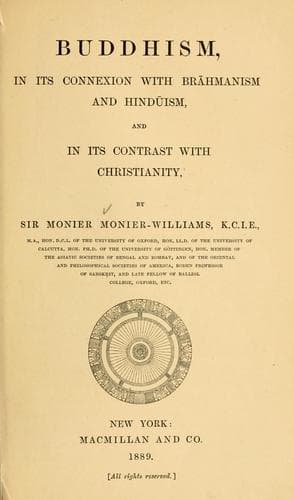
Buddhism, in Its Connexion with Brahmanism and Hinduism, and in Its Contrast with ChristianityMonier-Williams, Monier, Sir
Religion
Buddhism, in Its Connexion with Brahmanism and Hinduism, and in Its Contrast with Christianity
Monier-Williams, Monier, Sir
Buddhism; Buddhism -- Relations -- Christianity; Christianity and other religions -- Buddhism; India -- Religion
Next Deva-datta climbed up the Vulture’s Peak, and hurled down a
mighty rock on the Venerable One. But two mountain peaks came together
and stopped that rock. [Fā-hien says that it hurt one of his toes.
Legge, p. 83.] Now at that time there was at Rāja-gṛiha an elephant
named Nālāgiri, fierce and a man-slayer. And Deva-datta caused the
elephant to be let loose against Gotama. But the Venerable One infused
a sense of love into the elephant. And the elephant extended his trunk
and took up the dust from off the feet of the Venerable One and
sprinkled it over his own head, and retired bowing backwards, gazing
upon the Venerable One.
It may be noted here that the hell to which Deva-datta was condemned for
his attempts upon the Buddha’s life, is thus described by Burmese
authorities:—
The impious Deva-datta, a cousin and brother-in-law of the Buddha,
suffers terrible punishment in Hell. His feet are sunk ankle-deep in
burning marl. His head is incased with a red hot metal cap down to the
lobe of the ears. Two large red-hot bars transfix him from back to
front, two horizontally from right to left, and one impales him from
head to foot. (Shway Yoe’s ‘Burman,’ i. 121.)
It should be mentioned in connexion with Rāja-gṛiha that Ajāta-ṡatru
built a grand Stūpa there, over a portion of the Buddha’s ashes, soon
after his cremation.
Another fact which enhances the interest of this place is the
propinquity of the celebrated Satta-paṇṇi cave (p. 55), where the
Buddhist brotherhood first assembled after their leader’s death.
_Ṡrāvastī._
Ṡrāvastī (Pāli, Sāvatthī), sometimes spelt Ṡrāvasti, has been identified
by General Cunningham with a place now called Sāhet-Māhet, about
fifty-eight miles north of Ajūdhyā in Oudh. The town is said to derive
its name from the fact that it was built by a certain King Ṡrāvasta.
Other native authorities derive it from a Ṛishi named Sāvattha, who is
said to have resided there. It was certainly the ancient capital of
Kosala (Oudh), and was ruled over by King Prasena-jit (Pāli, Pasenadi),
who was Gautama’s contemporary. Moreover, it was the Buddha’s favourite
place of retreat[205] during the rainy seasons (p. 48 of this volume),
about half of his Vassas having been spent there[206] in the Jeta-vana
monastery built for him by the wealthy merchant Anātha-piṇḍika
(Anepidu), sometimes called Su-datta.
Doubtless on this account Ṡrāvastī was once much resorted to by the
Buddha’s followers, and ultimately became an important seat of Buddhist
learning.
Public-domain text, read in full here on John Shaqi.
Reviews
Reviews
No reviews yet
Be the first to share your thoughts on this work.
Elsewhere in the archive
Join the Discussion
Join the discussion
Sign in to leave a comment or review.
Sign InorCreate an account