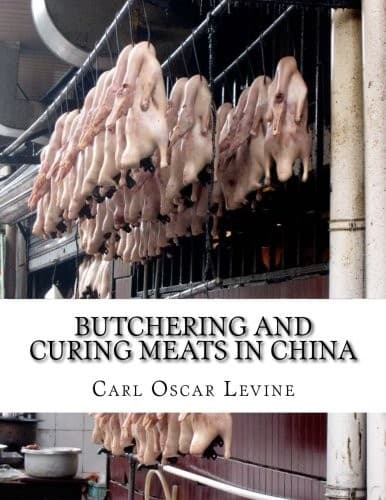
Butchering and curing meats in ChinaLevine, Carl Oscar
Science
Butchering and curing meats in China
Levine, Carl Oscar
Meat -- Preservation; Slaughtering and slaughter-houses -- China
The sticking knife should have a blade eight or nine inches long. In
America, a knife with straight edges, which at the end tapers to a
point is used, while in China, a knife tapering from two inches wide
at the handle to a long, narrow point is used. Either type of knife
will do. The knife should be thrust diagonally into the neck for about
six to eight inches of its length, depending on the size of the hog.
It should be inserted on the middle line of the body, about three or
four inches in front of the sternum, with the sharp edge of the knife
toward the rear and the knife pointed in the direction of the loin of
the hog. One hand of the operator should be held on the lower jaw of
the hog to help hold the animal steady. It will require a little
practice to stick properly. If rightly done, the large blood vessels
will be severed, the animal will bleed quickly, and be dead in less
than five minutes.
In large packing houses, where each man has a certain piece of work to
do, the hogs are hung by one leg upon a moving over-head track. As the
hogs move by the killer, he grasps one front leg with one hand, and,
with the other hand, does the sticking. Such an arrangement is
practical where a large number of hogs is killed daily.
§ 14. “Watered” Meat
There is a very common practice in China of increasing the weight of
the dressed hog carcass by forcing water into the meat as soon as the
blood has drained away and the scraping is finished. Water is forced
in through the large blood vessels leading away from the heart. To do
this properly, care is taken in sticking not to sever the large blood
vessels from the heart. This is accomplished by using a long, narrow
sticking knife, which is thrust into the heart itself. The animal thus
stuck bleeds into the chest cavity, which is not desirable, as the
bleeding will not be as thorough as when the large blood vessels only
are severed. The carcass of the hog may be increased several pounds by
this treatment. It is difficult to detect from the appearance of the
pork whether or not it has been watered. On roasting, watered meat
shrinks more than normal meat. Watered meat will spoil quicker than
normal meat, and will not cure well. The practice of “watering” meat
should be discouraged.
§ 15. Scalding and Scraping
Public-domain text, read in full here on John Shaqi.
Reviews
Reviews
No reviews yet
Be the first to share your thoughts on this work.
Join the Discussion
Join the discussion
Sign in to leave a comment or review.
Sign InorCreate an account