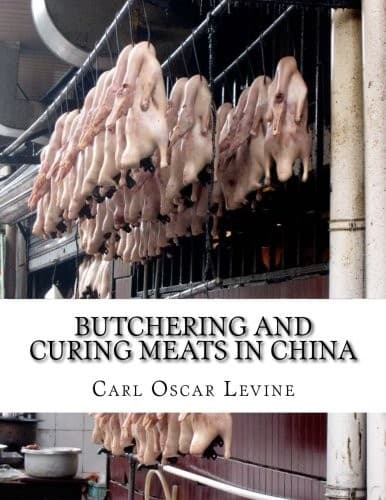
Butchering and curing meats in ChinaLevine, Carl Oscar
Science
Butchering and curing meats in China
Levine, Carl Oscar
Meat -- Preservation; Slaughtering and slaughter-houses -- China
In China, the water for scalding is heated in a sort of a furnace
commonly called _t’ong chue ts’o_. (劏豬灶). The furnace is made of
brick and concrete, or concrete only. It is usually about thirty-six
inches wide, six feet long, and twenty-eight inches high at one end,
gradually sloping to about twenty-six inches high near the other end,
where a large brass or iron basin for holding water is placed over a
fire grate. The basin in which the water is heated is usually about
twenty inches in diameter, eight inches deep in the center, and
diminishing in depth from the center to the rim. The shallow basin
with large contact with the fire obtains quick heating and saving of
fuel. The top of the furnace is made to slope from all sides toward
the bowl so that, when hot water is poured on the hog which lies on
the table, the water runs back into the basin.
§ 13. Killing the Hog
All tools and apparatus used in killing and handling the animal should
be ready before it is killed. The knives and saws should be sharp and
clean. The water should be near the boiling point and the block and
tackle ready, if one is to be used.
The common and most satisfactory method of killing the hog is by
severing the large arteries and veins in the neck of the animal with a
sticking knife about nine inches long. The animal should be laid on
its back and held firmly while it is being stuck. Two men can handle
a large hog if they work intelligently. By reaching under the animal and
grasping the opposite legs and suddenly jerking the legs, a heavy hog
can be easily turned over on its back. One man standing astride the
animal with his feet close against its sides, and holding the front
legs, can easily control it while the other does the sticking.
[Illustration: Fig. 5. Tools Used by Chinese in Butchering.
Lower Row Right to Left.
Sticking knife.
Cutting and scraping knives.
Heavy knife for cutting meat.
Knife for cutting bone.
Cleaver.
Funnel for Stuffing sausage casing.
Hook used in handling meat that is being roasted.
Tool used in roasting meat.
Upper Row Right to Left.
Cork with needles for pricking casing when it is being filled
in order to let out the air.
Hooks for handling carcass.]
[Illustration: Fig. 6. Hog scraped and hung up for gutting]
[Illustration: Fig. 7. Scraping the hog on the “_t’ong chue t’so_”]
It is a common custom with Chinese butchers to lay the hog across a
narrow bench for sticking. This requires more handling of the animal
then when the animal is simply turned over on its back on the floor,
or on a low table or box for the sticking.
Public-domain text, read in full here on John Shaqi.
Reviews
Reviews
No reviews yet
Be the first to share your thoughts on this work.
Join the Discussion
Join the discussion
Sign in to leave a comment or review.
Sign InorCreate an account