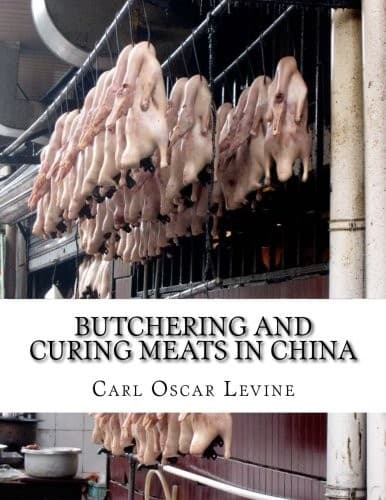
Butchering and curing meats in ChinaLevine, Carl Oscar
Science
Butchering and curing meats in China
Levine, Carl Oscar
Meat -- Preservation; Slaughtering and slaughter-houses -- China
The shoulder cut is made between the fourth and fifth ribs, where the
ribs leave the backbone. The cut should be made at right angles with
the top and bottom edges of the middle piece in order to make a
rectangular middle piece. This necessitates a diagonal cut across the
end of the fourth rib. If the shoulders are to be cured, remove the
ribs and the backbone from the shoulder piece. Cut close to the ribs
in removing them in order to leave as much meat on the shoulder as is
possible. Cut off the top of the shoulder with about one and one-half
inches of the cartilage and bone at the top. This removes most of the
fat meat and trims the shoulder for curing. The shoulder should be
further trimmed by cutting off rough parts with a sharp knife.
§ 20. Middle Part
Separate the hams from the middle by cutting just back of the
beginning of the rise in the backbone. The ribs should be separated
from the side meat. If it is desired to make pork chops, care should
be taken to leave the long muscle on either side of the backbone
attached to the backbone and ribs. The end of the ribs should then be
cut off with a cleaver, leaving about three inches of the ribs
attached to the backbone to form part of the chops. In preparing the
chops for roasting, cuts should be made through the meat between the
ribs and between the vertebrae.
It is the custom for butchers in Canton to remove all the meat from
the ribs and backbone. The sides are then cut into strips about one
inch wide, cutting from the top to the bottom, and used, fresh or
cured. The ribs and backbone are then cut into small parts and
prepared in a very tasty way with a sweet dressing. The dish prepared
in this manner is known as _chue p’aai kwat_ (豬排骨).
If the side meat is to be made into cured bacon, the first method of
separating the ribs from the meat is followed. This leaves the side
meat about one and a half to two inches thick. The strip of pure fat
meat along the top, known as the fat back, the strip of belly fat at
the bottom, up to, and including the teats, should be removed. The
middle piece which is left after thus trimming, is used for making
cured bacon. The fat back and the belly strip can be used for lard.
§ 21. Hams
If the hams are to be cured, all sharp points should be smoothed off,
giving a neat, rounded shape to the ham.
§ 22. Trimmings
The small pieces of meat cut from the shoulders, hams, and middle
pieces in trimming, maybe used fresh, or made into sausage. The fat of
the trimmings may be used for making lard.
§ 23. Head
The fattest part of the head may be used for lard, or cut into strips
about three quarters of an inch wide and cured, or it may be used for
making sausage or head cheese. The snout, ears, and tongue may be used
fresh or pickled.
§ 24. Feet
The small amount of meat on the feet is considered very delicious. The
feet may be either cooked for immediate use, or they may be pickled.
Killing and Dressing Beef
§ 25. Tools
Public-domain text, read in full here on John Shaqi.
Reviews
Reviews
No reviews yet
Be the first to share your thoughts on this work.
Join the Discussion
Join the discussion
Sign in to leave a comment or review.
Sign InorCreate an account