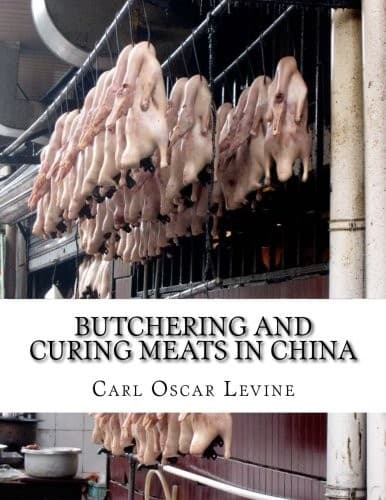
Butchering and curing meats in ChinaLevine, Carl Oscar
Science
Butchering and curing meats in China
Levine, Carl Oscar
Meat -- Preservation; Slaughtering and slaughter-houses -- China
The following tools are necessary for killing and dressing cattle: an
ax, an 8-inch sticking knife, a skinning knife, a steel for sharpening
the knives, a 28-inch meat saw, gambrel, and a block and tackle for
hoisting up the carcass.
§ 26. Stunning
The first step in killing and dressing beef is to secure the animal so
that it cannot possibly break loose. A strong halter, or new half-inch
rope, tied around the neck and with one end tied to a ring in the
floor, or to a tree, works very well. If the animal has a ring or a
bar through the nose, as most cattle have in China, it should be
further secured by tying with a strong rope attached to the ring or
bar. The animal should be tied very short so that it cannot move its
head to any extent.
Stunning is done in two ways. One method is to strike a heavy blow
with a stunning ax, weighing about three pounds, made especially for
the purpose, with an extension head about an inch in diameter which
readily crashes through the bone covering the brain, and into the
brain itself. The blow should be struck in the center of the forehead.
An ordinary ax with a long handle, can be used, although the kind
described above is best, in that it is sure to stun the animal, and
thus is most humane. The other method which is commonly used in
southern China, is to strike just back of the poll, and dislocate the
atlas joint. This is just as effective as a blew on the forehead, if
the blow is struck with enough force. Water buffalos have a very hard
skull and for this reason are sometimes shot. The end of the gun
should be held close to the head and carefully aimed at a point in the
center of the forehead, where lines would cross if drawn from the base
of the right horn to the left eye, and from the base of the left horn
to the right eye.
§ 27. Bleeding
The animal should be bled immediately after stunning or shooting. To
do this properly requires practice. With the stunned animal lying
stretched out on the floor, stand at its throat with the back toward
its body. Place one foot against the jaw, and with the other hold back
the front legs of the animal. Reaching down between the feet, lay open
the skin from the breast toward the chin for a distance of about ten
inches, using the ordinary skinning knife. Insert the knife with the
back against the breastbone and the tip directed toward the spinal
column at the top of the shoulders, cutting just under the windpipe,
and about five or six inches deep. The vein and the artery cross at
this point, and if they are severed, the blood will flow out very
rapidly. When the vein has been cut below the windpipe, run a knife in
on top of the windpipe and sever the blood vessels on that side also.
If stuck too deep, the pleura will be punctured and the blood will
flow into the chest cavity, causing a bloody carcass, which is not
desirable.
Public-domain text, read in full here on John Shaqi.
Reviews
Reviews
No reviews yet
Be the first to share your thoughts on this work.
Join the Discussion
Join the discussion
Sign in to leave a comment or review.
Sign InorCreate an account