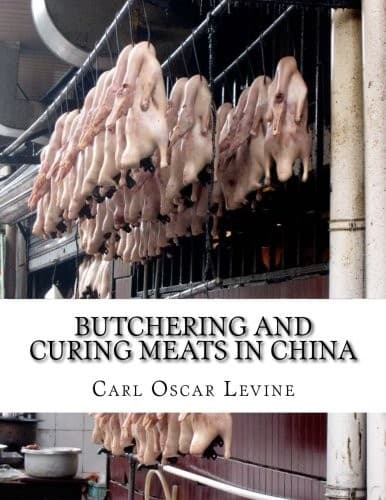
Butchering and curing meats in ChinaLevine, Carl Oscar
Science
Butchering and curing meats in China
Levine, Carl Oscar
Meat -- Preservation; Slaughtering and slaughter-houses -- China
In the north, meat may be kept fresh during the cold season by
freezing it solid. The carcass may be cut into quarters or smaller
pieces and hung in an open outbuilding where it will freeze solid, and
remain frozen until the weather begins to warm up in the spring.
Whenever a piece is wanted it can be removed with a saw. Rapid thawing
of frozen meat greatly injures its flavor. If the meat is thawed out
slowly in a cold room, the flavor of the meat will not be injured.
Meat can be kept frozen for months if kept in cold room, or in a
refrigerator with a temperature below 32 degrees Fahrenheit and with
proper ventilation provided.
Curing Meats: American Methods
§ 34. Preparing the Meat for Curing
Meat should be thoroughly cooled before it is cured, or it will spoil.
The proper time to begin curing is when the meat is cooled and still
fresh. Twenty to thirty hours after killing is the proper time to
begin the cure. If salted before the animal heat has left it, the
shrinkage of muscles causes a retention of gases, and gives an
offensive odor to the meat. The meat should not be frozen, as the cure
will not penetrate such meat evenly, and an uneven curing will result.
Tainted meat may be cured so that it will keep, but no system of
curing will bring back the natural flavor of the meat, if it is once
lost.
§ 35. Vessels for Curing
Vitrified clay jars, with straight sides, similar to the jars used for
fermenting beans in making soy bean sauce, are the best vessels for
containing the meat. These jars, large enough to hold conveniently the
hams, shoulders, and sides of two hogs, are best for curing meat for
the first time, and the meat can be watched and cared for better in
small jars than in large jars containing more meat. In America, where
such jars are expensive, it is the custom to use a clean, hardwood
barrel for the purpose. One that has been used for syrup or molasses
is best. If a kerosene or tar barrel is used, it should be first
thoroughly burned out, and used as a water barrel for some time before
it is used for meat. Vitrified clay jars are preferred to wooden
barrels as they are cleaned more readily. If meat has once spoiled in
a wooden barrel, the vessel should not be used again for containing
meat. Vessels that are used repeatedly for curing meat should be
scalded thoroughly each time before packing with fresh meat.
§ 36. Curing Agents
Salt, saltpeter, sugar or molasses, and a variety of spices are the
principal preservatives used in curing meat. Borax, formalin,
salicylic acid, and other chemicals are sometimes used. However, as
they are considered by many authorities to be injurious to the health,
their use should be avoided. Baking soda is used in wet pickles to
check the growth of mould.
Public-domain text, read in full here on John Shaqi.
Reviews
Reviews
No reviews yet
Be the first to share your thoughts on this work.
Join the Discussion
Join the discussion
Sign in to leave a comment or review.
Sign InorCreate an account