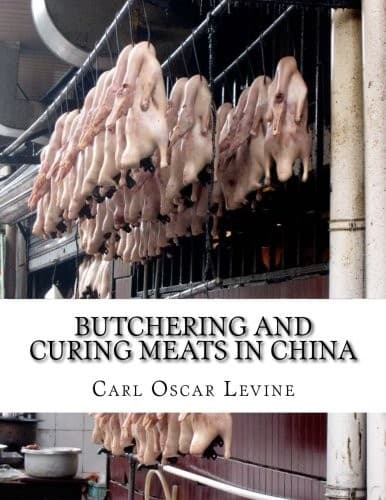
Butchering and curing meats in ChinaLevine, Carl Oscar
Science
Butchering and curing meats in China
Levine, Carl Oscar
Meat -- Preservation; Slaughtering and slaughter-houses -- China
When salt alone is applied to meat, it draws out the meat juices and
contracts the muscle fibers, making the meat very hard and dry. The
action of the sugar or the molasses is to soften the muscle fibers and
improve the texture and flavor of the meat, hence the combination of
sugar and salt make a good cure. Saltpeter is used to preserve the
natural red color of the meat. It should be used in small quantities
only, as it is very astringent, and, if used in large quantities is
apt to be injurious to the health.
Wet and Dry Cures Compared
A wet cure is more convenient than a dry cure. It is less trouble to
pack the meat in a jar or barrel and pour on the prepared wet pickle
than it is to go over the meat three or four times and rub in the
spices. The brine method also gives protection from insects. However,
in warm weather, the brine has to be watched very closely, and, if
mould forms on the surface of the pickle, it should be removed every
day or two. The brine also needs to be recooked every week or ten days
in warm weather to prevent undesirable bacteria from growing in it. A
cool, dry room is the best for either brine or dry curing. In a dry
atmosphere below 60 degrees Fahrenheit there is very little danger of
the meat becoming sour, although a temperature below 40 degrees is
better.
Recipes for Curing Meat
§ 37. Corned Beef
Any piece of beef can be used for corning, but the cheaper cuts are
the parts generally used for this purpose. The plate, rump, and parts
of the chuck are generally used, although the ribs, loin, and round
may also be used. The pieces for corning should be cut into pieces of
convenient size, say four or five inches square. If they are cut much
larger, they well not cure very well as the pickle will not work in
soon enough. They should be cut as nearly the same size as is possible
so they will pack in even layers in the barrel or jar.
When as the meat is thoroughly cooled, it should be corned as quickly
as possible. Weigh the meat and allow 10 pounds of salt for each 100
pounds of meat. Sprinkle a layer of salt a half inch deep over the
bottom of the jar in which the meat is to be placed. Rub each piece of
meat with good, clean salt. Pack each layer of meat closely in the
bottom of the jar, and sprinkle a layer of salt one-fourth to one-half
inch deep on each layer of meat before the following layer of meat is
placed in the jar, and cover the top layer of meat with a good layer
of salt. After it has stood over night, cover with a brine made as
follows: for each one hundred pounds of meat, use four pounds of
sugar, six ounces baking soda, and eight ounces of saltpeter. Dissolve
in a gallon of water that has been boiled and cooled until it is
tepid. Three gallons more of boiled, tepid water should then be added.
Meat from fat animals makes choicer corned beef than that from poor
animals. Under no circumstances should meat be corned while it is
frozen.
Public-domain text, read in full here on John Shaqi.
Reviews
Reviews
No reviews yet
Be the first to share your thoughts on this work.
Join the Discussion
Join the discussion
Sign in to leave a comment or review.
Sign InorCreate an account