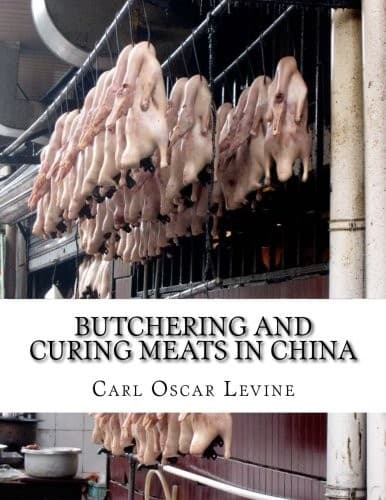
Butchering and curing meats in ChinaLevine, Carl Oscar
Science
Butchering and curing meats in China
Levine, Carl Oscar
Meat -- Preservation; Slaughtering and slaughter-houses -- China
Snow packing is a method that can be used only in localities where
snow and continued dry cold weather prevails during the winter months.
The carcass should be cut into steaks, roasts, and boiling pieces. All
trimmings for the table should be made before freezing the meat. Lay
the pieces out to freeze. Be sure they freeze solid to the center. In
the bottom of a box large enough to hold all the meat, pack a layer of
snow. Put in a larger of the frozen meat, packing in such a way that
the pieces do not touch each other. Cover with a layer of snow, and
continue with alternate layers of meat and snow. Set the box in a room
where it will not be subject to changes in temperature. For
convenience, it is well to pack the steaks in one section or end of
the box, and the roasts and stews in another. The meat will then be
but little disturbed when a supply is taken from the box. Only snow
should be used in packing. Be sure the meat is frozen solid before
packing, and it will keep through the winter, unless the weather gets
very warm. In preparing the meat for the table, it should not be
thawed out too rapidly.
§ 53. Partial Cooking
Partial cooking and packing in jars is a method of preserving meat
which is sometimes used on the farm. It has the advantage over snow
packing in that it can be done in warm weather and is a most
satisfactory way of keeping fresh pork. However, it requires
considerably more work than other methods of preserving meat.
The loin and side meat, or any part of the carcass, may be used. Cut
into slices about one-half inch thick, and fry until a little more
than half done. Pack the slices in a jar and cover with hot lard. As
the meat is wanted, it can be removed from the jar and warmed up. If
the jar is to stand any length of time without using, after it has
been opened, it is best again to cover the top with lard. It is better
to use several small jars than one large one. They should be kept in a
cool, dark room to insure safe-keeping of the meat.
§ 54. Rendering Lard
The leaf lard, fat back, and fat trimmings from the hams, shoulders
and neck make good lard. Intestinal fat should never be mixed with the
other fat parts, as it makes a strong smelling lard of an inferior
grade, but should be rendered by itself. By thorough washing and
soaking in cold water for several hours, part of the offensive odor
will leave it.
Public-domain text, read in full here on John Shaqi.
Reviews
Reviews
No reviews yet
Be the first to share your thoughts on this work.
Join the Discussion
Join the discussion
Sign in to leave a comment or review.
Sign InorCreate an account