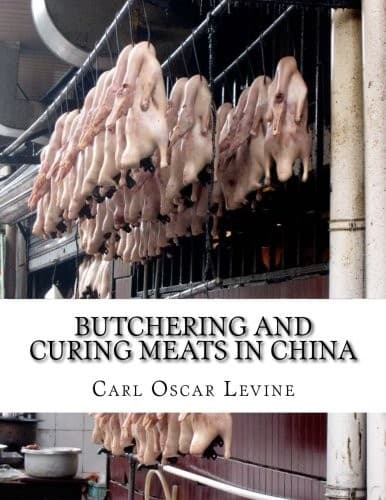
Butchering and curing meats in ChinaLevine, Carl Oscar
Science
Butchering and curing meats in China
Levine, Carl Oscar
Meat -- Preservation; Slaughtering and slaughter-houses -- China
First of all, remove the skin from the fat trimmings. To do this,
place the meat on a table, skin side down, and cut the fat from the
skin, using a strong knife. When a piece of skin large enough to grasp
is freed from the fat, take it in the left hand, and, with the right
hand, insert the knife between the skin and fat. Pull the skin and cut
with the knife slightly slanted downward. With a little practice, the
fat can be cleanly removed from the skin in this way with one clean
cut of the knife. The strips of fat should then be cut into cubes of
one to one and one-half inches, making them about equal in size so
they will try out evenly.
Pour into the kettle about a quart of water or melted lard, and then
fill it nearly full with the cubes of fat meat. The fat will then heat
properly and the lard will be brought out without burning. Keep a
moderate fire until the cracklings are brown and light enough to
float. Frequent stirring is necessary to prevent burning. When done,
remove from the fire and allow to cool slightly. Then strain through a
muslin cloth into a jar. Stir it occasionally, until it is cool enough
to begin to solidify. Stirring while it is cooling tends to whiten the
lard and make it smoother. A quarter of a pound of saleratus added to
each one hundred pounds of fat has a like effect.
When removing lard from a container for use, take it evenly from the
surface. Do not dig down into the center of the lard, for when this is
done, it will leave a coating of lard around the sides of the
container which will become rancid very quickly by the action of
bacteria in the air.
§ 55. Smoked Meats
The process of smoking helps to preserve meat, and, if smoked
properly, and with the right kind of fuel, adds a desirable flavor to
meat. The creosote formed by the combustion of the wood closes the
pores to some extent, and excludes the air. This also helps to keep
out the insects.
§ 56. The Smokehouse
The size of smokehouse to build depends on the amount of meat that is
to be smoked. In a house eight feet square and ten feet high, the
hams, sides, and shoulders of three to five hogs can be smoked at one
time. Ventilation should be provided to carry off the warm air in
order to prevent overheating the meat. A chimney, made by placing a
six inch tile in the roof, makes a good ventilator. The smoke house
walls may be built of lumber, brick, or concrete. Lumber would be the
cheapest, but least permanent, and concrete the most costly. Brick is
no doubt the most satisfactory material for a small smoke house in
southern China. Mud bricks may be used, but burnt clay bricks are more
lasting. The roof should be made of tile. The best material for the
floor is large square tiles, called in Chinese _taai ch’uen_ (大磚).
Concrete or brick may also be used, but would be more expensive then
_taai ch’uen_.
Public-domain text, read in full here on John Shaqi.
Reviews
Reviews
No reviews yet
Be the first to share your thoughts on this work.
Join the Discussion
Join the discussion
Sign in to leave a comment or review.
Sign InorCreate an account