Cacao Culture in the PhilippinesLyon, William Scrugham
Science
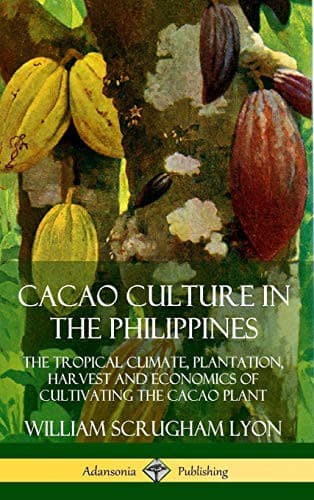
Cacao Culture in the Philippines
Lyon, William Scrugham
Cacao
It may be said for the benefit of those unable to adopt more scientific
methods: Let the seed bed be selected in a well-shaded spot, and, if
possible, upon a rather stiff, plastic, but well-drained soil. After
this is well broken up and made smooth, broadcast over all 3 or 4
inches of well-decomposed leaf mold mixed with sand, and in this sow
the seed in furrows about 1 inch deep. This sowing should be made
during the dry season, not only to avoid the beating and washing
of violent storms but to have the nursery plants of proper size for
planting at the opening of the rainy season. The seed bed should be
accessible to water, in order that it may be conveniently watered by
frequent sprinklings throughout the dry season.
The rich top dressing will stimulate the early growth of the seedling,
and when its roots enter the heavier soil below it will encourage a
stocky growth. Four or five months later the roots will be so well
established in the stiffer soil that if lifted carefully each plant
may be secured with a ball of earth about its roots, placed in a tray
or basket, and in this way carried intact to the field. Plants thus
reared give to the inexperienced an assurance of success not always
obtained by the trained or veteran planter of bare rooted subjects.
CULTIVATION.
Planters are united in the opinion that pruning, cutting, or in any
way lacerating the roots is injurious to the cacao, and in deference
to this opinion all cultivation close to the tree should be done with
a harrow-tooth cultivator, or shallow scarifier. All intermediate
cultivation should be deep and thorough, whenever the mechanical
condition of the soil will permit it. A plant stunted in youth will
never make a prolific tree; early and continuous growth can only be
secured by deep and thorough cultivation.
Of even more consideration than an occasional root cutting is any
injury, however small, to the tree stem, and on this account every
precaution should be taken to protect the trees from accidental injury
when plowing or cultivating. The whiffletree of the plow or cultivator
used should be carefully fendered with rubber or a soft woolen packing
that will effectually guard against the carelessness of workmen. Wounds
in the bark or stem offer an inviting field for the entry of insects
or the spores of fungi, and are, furthermore, apt to be overlooked
until the injury becomes deep seated and sometimes beyond repair.
With the gradual extension of root development, cultivation will
be reduced to a narrow strip between the rows once occupied by the
plantain or the abacá, but, to the very last, the maintenance of the
proper soil conditions should be observed by at least one good annual
plowing and by as many superficial cultivations as the growth of the
trees and the mechanical state of the land will admit.
PRUNING.
Public-domain text, read in full here on John Shaqi.
Reviews
Reviews
No reviews yet
Be the first to share your thoughts on this work.
Join the Discussion
Join the discussion
Sign in to leave a comment or review.
Sign InorCreate an account