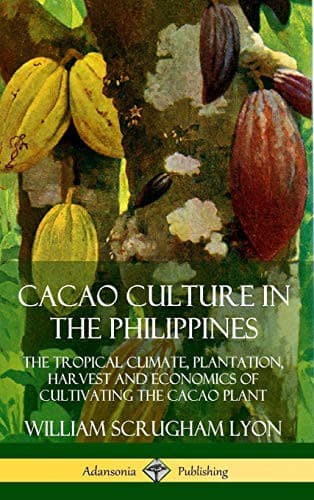
Cacao Culture in the PhilippinesLyon, William Scrugham
Science
Cacao Culture in the Philippines
Lyon, William Scrugham
Cacao
When left to its own resources the cacao will fruit for an almost
indefinite time. When well and strenuously grown it will bear much more
abundant fruit from its fifth to its twenty-fifth year, and by a simple
process of renewal can be made productive for a much longer time.
A necessary factor to this result is an annual pruning upon strictly
scientific lines. The underlying principle involved is, primarily,
the fact that the cacao bears its crop directly upon the main branches
and trunk, and not upon spurs or twigs; secondly, that wood under
three years is rarely fruitful, and that only upon stems or branches
of five years or upward does the maximum fruitfulness occur; that the
seat of inflorescence is directly over the axil of a fallen leaf, from
whence the flowers are born at irregular times throughout the year.
With this necessary, fundamental information as a basis of operations,
the rational system of pruning that suggests itself is the maintenance
of as large an extension at all times of straight, well-grown mature
wood and the perfecting of that by the early and frequent removal
of all limbs or branches that the form of the tree does not admit of
carrying without overcrowding.
It is desirable that this extension of the branch system should be
lateral rather than vertical, for the greater facility with which
fruit may be plucked and possible insect enemies fought; and on this
account the leading growths should be stopped when a convenient height
has been attained.
When well grown and without accident to its leader, the cacao will
naturally branch at from 1 to 1.4 meters from the ground. These
primary branches are mostly three to five in number, and all in
excess of three should be removed as soon as selection can be made
of three strongest that are as nearly equidistant from each other
as may be. When these branches are from 80 cm. to 1 meter long, and
preferably the shorter distance, they are to be stopped by pinching
the extremities. This will cause them and the main stem as well to
"break," i. e., to branch in many places.
At this point the vigilance and judgment of the planter are called
into greater play. These secondary branches are, in turn, all to
be reduced as were the primary ones, and their selection can not be
made in a symmetrical whorl, for the habit of the tree does not admit
of it, and selection of the three should be made with reference to
their future extension, that the interior of the tree should not be
overcrowded and that such outer branches be retained as shall fairly
maintain the equilibrium of the crown.
Public-domain text, read in full here on John Shaqi.
Reviews
Reviews
No reviews yet
Be the first to share your thoughts on this work.
Join the Discussion
Join the discussion
Sign in to leave a comment or review.
Sign InorCreate an account