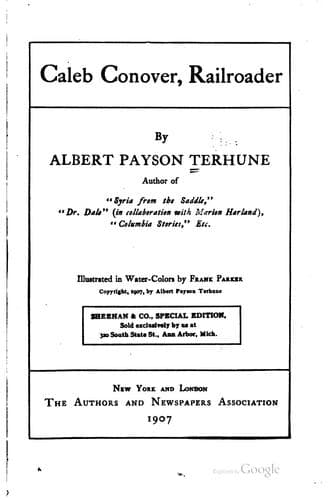
American fiction -- 20th century; Political fiction; Railroad stories; West (U.S.) -- Fiction
Clive had a fair idea of the “standing” in question. A half-baked lad,
turned out of Harvard after two years of futile loafing, sent on a trip
around the world (that culminated in a delightfully misspent year in
Paris), at last coming home with a well-grounded contempt for his native
city, and turned loose at his own request on long-suffering New York,
with more money than belonged to him and fewer brains than sufficed to
keep it. This in a nutshell was the history—so far as the world at large
knew—of Caleb Conover’s only son.
From time to time newspaper accounts of beaten cabmen, suppers that
ended in police stations, and similar feats of youthful gayety and
culture had floated to Granite. Yet Caleb Conover, otherwise so rigid in
the matter of appearances, read such accounts with relish, and boasted
loudly of the swath his son was cutting in Gotham society. For, on
Gerald’s word, Conover was firmly assured that this was the true career
of a young man of fashion. It represented all he had missed in his own
poverty-fighting early manhood, and he rejoiced in his son’s good times.
Getting rid of Gerald as soon as he decently might, Standish made his
way to the supper-room. At a hundred tables sat more or less bored
guests. Waiters swirled wildly to and fro. In a balcony above blared an
orchestra. At the doors and in a fringe about the edges of the room were
grouped the Conover political and business hangers on. The place was hot
to suffocation and heavy with the scent of flowers.
Suddenly, through the volume of looser sound, came a succession of sharp
raps. The orchestra stopped short. The guests ceased speaking, and
craned their necks.
At the far end of the room, under a gaudy floral piece, a man had risen
to his feet.
“Speech!” yelled Shevlin, enthusiastically, from a doorway. Then, made
aware of his breach of etiquette by a swift but awful glance from his
chief, he wilted behind a palm.
But Shevlin had read the signs aright.
Caleb Conover, Railroader, was about to make a speech.
CHAPTER II
CALEB CONOVER MAKES A SPEECH
Conover had broken, that night, two rules that had for years formed
inviolate tenets of his life creed. In the first place, he—whose battles
had for the most part been won by the cold eye that told nothing, and by
the colder brain that dictated the words of his every-day speech as
calculatingly as a diplomat dictates a letter of state—he had forced
himself to throw away his guard and to chatter and make himself
agreeable like any bargain counter clerk. The effort had been irksome.
Public-domain text, read in full here on John Shaqi.
Reviews
Reviews
No reviews yet
Be the first to share your thoughts on this work.
Join the Discussion
Join the discussion
Sign in to leave a comment or review.
Sign InorCreate an account