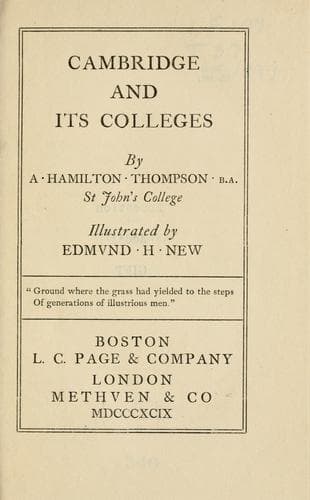
Cambridge and Its CollegesThompson, A. Hamilton (Alexander Hamilton)
History
Cambridge and Its Colleges
Thompson, A. Hamilton (Alexander Hamilton)
University of Cambridge
Cambridge, no less than Oxford, took her part in the religious commotions
of the sixteenth century. She was deeply concerned in the revival of
learning. She shares with Oxford the honour of enrolling Waynflete and
Foxe among the members of the University. Bishop Fisher belongs entirely
to her, and, in consequence, Cambridge was the University which the Lady
Margaret favoured more conspicuously. Erasmus taught in her schools. Even
before the Dissolution, she showed, by her appropriation of religious
houses to scholastic purposes, the growth of that liberal spirit which
is thought to be her intellectual distinction. We shall see how pious
Churchmen like Bishop Alcock and a medieval devotee like Lady Margaret
did not scruple to sweep away monasteries for the sake of learning.
Even monasteries themselves, in these later days, followed up their
own initiative and endowed colleges. Several abbeys united to found
Buckingham College. Alcock, by virtue of his episcopal office, was abbot
of the great monastery of Ely. In the great struggle which followed the
revival of learning as its natural outcome, Cambridge contributed her
martyrs to both sides. Fisher died in the defence of a rigid principle.
On the other hand, Cambridge prepared those three reformers who suffered
for their opinions at Oxford. Cranmer was a fellow of Jesus, Ridley
was Master of Pembroke, Latimer belonged to the societies of Christ’s
and Clare. It is not at all surprising that their influence, combined
with the constant importation of Genevan teachers, rendered Cambridge
very susceptible for a time to reformed doctrine of a foreign type. But
the final result of the Reformation in the University is shown by the
intellectual freedom of her greatest sons. Bacon and Sir Isaac Newton
are the obvious examples of this, but their illustrious personalities
should not allow us to forget the brilliant ingenuity of the Cambridge
Platonists; while, side by side with the greatest of all we may place the
name of John Milton.
Public-domain text, read in full here on John Shaqi.
Reviews
Reviews
No reviews yet
Be the first to share your thoughts on this work.
Join the Discussion
Join the discussion
Sign in to leave a comment or review.
Sign InorCreate an account