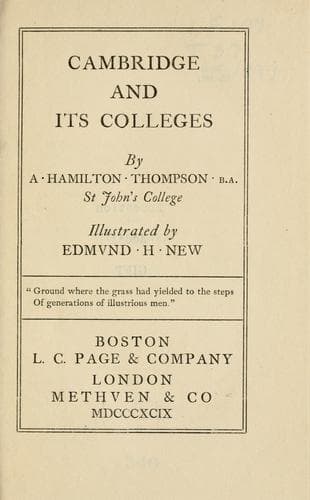
Cambridge and Its CollegesThompson, A. Hamilton (Alexander Hamilton)
History
Cambridge and Its Colleges
Thompson, A. Hamilton (Alexander Hamilton)
University of Cambridge
At Stourbridge Fair University and Town took joint management of the
proceedings. They did not, however, love one another very cordially,
and the Town resented the rights which the University enforced with
some arrogance. “Town and Gown rows” were, in the ordinary course of
things, not very common. When they broke out, they were serious; but
usually the University was much to blame. For example, in James I.’s
time, George Ruggle, fellow of Clare, wrote a play in derision of the
town’s folk, to which the college, with the worst taste, invited the
Mayor and Corporation. But that the town, at any rate in medieval times,
watched the growth of the University with favour, is sufficiently proved
by the refoundation of Corpus Christi College, the work of townspeople.
The University repaid the debt in subsequent years by foundations like
Perse’s Grammar School and Addenbrooke’s Hospital. We must remember that,
ecclesiastically, the connection of town and university was for some
centuries very close. The church of St Mary by the Market was not merely
the chapel of King’s Hall; it was also a parish church, and a large and
important gild of merchants had their chapel within its walls. At first,
the colleges were entirely opposed to the monastic spirit. They did not
worship in their own chapels, but joined in the devotions of the ordinary
congregations, going to church just as the grammar school of any town in
England attends the parish church, as a matter of course. The extreme
youth of the scholars completes the comparison. But, as the colleges grew
in riches and numbers, they reverted to the monastic ideal, and each
built its own chapel. The Town and University drew apart from each other,
and the University became the more important body. Moreover, while the
learning of the University grew, the trade of the town diminished. The
gradual diversion of trade from the Eastern Counties, the decay of ports
like Lynn, with whose commerce Cambridge was inseparably linked, all the
changes in the physical geography of the Fens, reduced the importance
of the town. It would be unfair to assert that Cambridge, as a whole,
exists for the sake of the University; but there is no doubt that the
nucleus of the town, its whole western quarter, is devoted to that
purpose, and that, without the University, it would be of little more
importance than Huntingdon or St Ives—of less importance, probably, than
Ely or Wisbech, which are still at the head of an excellent water-way.
Public-domain text, read in full here on John Shaqi.
Reviews
Reviews
No reviews yet
Be the first to share your thoughts on this work.
Join the Discussion
Join the discussion
Sign in to leave a comment or review.
Sign InorCreate an account