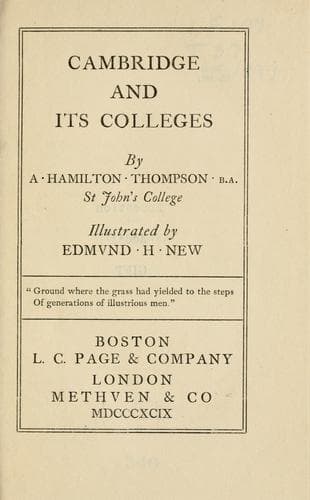
Cambridge and Its CollegesThompson, A. Hamilton (Alexander Hamilton)
History
Cambridge and Its Colleges
Thompson, A. Hamilton (Alexander Hamilton)
University of Cambridge
At this time, the mathematical attainments of the Society must have
been overpowering. Barrow’s fame in this department has perhaps been
obscured by that of Sir Isaac Newton; but, if we are to believe Newton’s
generous compliment, the early death of Roger Cotes robbed Trinity of an
even greater prodigy. The college may nevertheless be well content with
Newton, who was emphatically a Trinity man, spending very little of his
life away from Cambridge. He was twelve years younger than Barrow, and
entered Trinity in the year of the Restoration, when he was eighteen.
Nine years later, his studies proved so fruitful that Barrow gave up the
Lucasian professorship in his favour. For more than half a century, he
was the chief ornament of the University. His discoveries revolutionised
the whole theory of mathematics, and it was owing to his personality
that the subsequent energies of Cambridge were so largely mathematical.
He occupied rooms between the Great Gateway and the Chapel. Although he
made Cambridge his home, he had a large share in public business, sitting
as Member for the University and receiving the mastership of the Mint.
This office he probably owed to another member of the college, Charles
Montague, Earl of Halifax (* Kneller), whose recall of the specie is
among the most famous of English financial operations. In 1703, Newton
was elected President of the Royal Society, which, it is interesting to
note, had been founded, forty years before, mainly through the energy of
Dr Wilkins, Master of Trinity and one of the three Bishops of Chester
mentioned above. Newton was knighted by Queen Anne in 1705, and died in
1727. His scientific studies were not his exclusive pursuits, for he
was, to a certain extent, one of the group of literary men who are the
glory of Anne’s reign, and was also much occupied with the elucidation
of prophecy, which probably attracted him from its mathematical side.
Trinity has very justly regarded him as her greatest son. His portrait,
by Ritz, occupies the place of honour in the Hall, and every visitor to
Cambridge knows—
The antechapel where the statue stood
Of Newton with his prism and silent face,
The marble index of a mind for ever
Voyaging through strange seas of Thought, alone.
The statue, which is by Roubiliac, and is that master’s most famous
work, bears the inscription from Lucretius “Qui genus humanum ingenio
superavit.” There is a bust of him in the Library, also by Roubiliac, and
several portraits are to be found throughout the college.
Public-domain text, read in full here on John Shaqi.
Reviews
Reviews
No reviews yet
Be the first to share your thoughts on this work.
Elsewhere in the archive
Join the Discussion
Join the discussion
Sign in to leave a comment or review.
Sign InorCreate an account