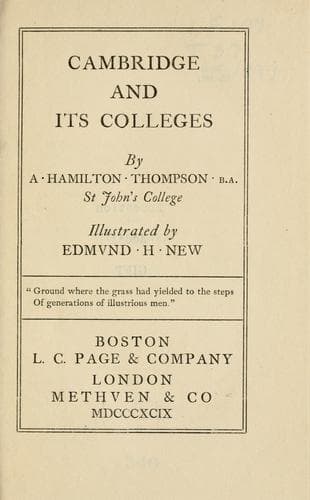
Cambridge and Its CollegesThompson, A. Hamilton (Alexander Hamilton)
History
Cambridge and Its Colleges
Thompson, A. Hamilton (Alexander Hamilton)
University of Cambridge
After Barrow’s death, the mastership was filled successively by the
Hon. John North* and the Hon. John Montague,* whose rule was calculated
to foster a comfortable laziness rather than industry. On the death
of the second of these, Dr Richard Bentley, fellow of St John’s, was
elected master. There was, in those days, a strong feeling of rivalry
between the two foundations—not only academical, but also in political
and social matters. Bentley was a rare genius, whose scholarship was
just then acknowledged as the finest in England, but he was utterly
devoid of good feeling and tact, and had a peculiar faculty for exciting
hatred. His fame, for the most of us, is due to his high place in
the _Dunciad_. He arrived in Trinity with the intention of managing
the college on his own lines. There was a party in the Society which
thoroughly enjoyed the comfort of a position it did not adorn, and in
this body Bentley found his most devoted enemies. Instead of conciliating
them, he treated them with undisguised contempt and arrogance; and his
conduct was so injudicious that he alienated all the better members
of the college from himself. Matters came to a head when Bentley made
radical alterations in the Master’s Lodge, and presented the fellows
with a bill considerably larger than the original estimate. Open war
broke out; the fellows refused to pay; and Bentley in consequence applied
methods of coercion, withholding privileges which were in his gift. The
fellows found themselves obliged to give in after some time, and Bentley
followed up this victory by altering the interior of the chapel to suit
the new organ. At this point, however, the Society revolted for good.
Bentley required a large subscription of each fellow. The fellowship
dividends had been much reduced during the previous years, and, with this
additional burden, poverty stared many of the dons in the face. In this
crisis, the fellows, who undoubtedly had justice on their side, called
in Serjeant Milne, a London lawyer and one of their number, and, under
his guidance, addressed a _gravamen_ against the Master to the Bishop of
Ely. Things would have gone hardly for Bentley, had not the Bishop died
opportunely. This Bishop, by the way, was John Moore, whose books George
I. gave to the University Library. However, Bentley’s tyranny was not
suffered to continue, for, in 1718, the Senate passed a grace degrading
him from his high positions in the University. After this, the quarrel
was less prominent. Bentley occupied the Lodge till 1742, but the bad
feeling which he had excited continued till the end of his life. His
judgment and taste may be estimated from the reply which he is said to
have given to some congratulatory address after his election. Referring
to his original college of St John’s, he said, “By the help of my God,
I have leaped over a wall.” His arrogance might have been excusable in
a young man whose promotion was early, but Bentley, in 1700, was past
middle life.
Public-domain text, read in full here on John Shaqi.
Reviews
Reviews
No reviews yet
Be the first to share your thoughts on this work.
Elsewhere in the archive
Join the Discussion
Join the discussion
Sign in to leave a comment or review.
Sign InorCreate an account