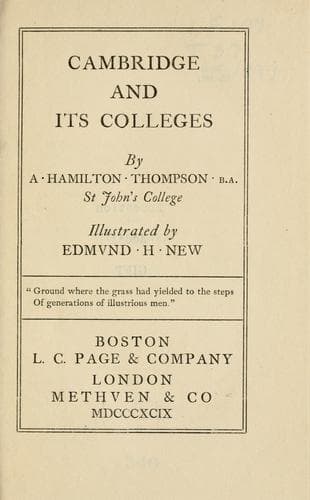
Cambridge and Its CollegesThompson, A. Hamilton (Alexander Hamilton)
History
Cambridge and Its Colleges
Thompson, A. Hamilton (Alexander Hamilton)
University of Cambridge
His scholarship was sound, and there is no doubt that his
arguments against the Epistles of Phalaris crushed the position of his
adversary Boyle; but his lack of proper feeling always put him in the
wrong, and his memory lives in the satire of Pope and Swift rather than
in his own work. Hudson’s portrait of him is in the Hall, and his bust,
by Roubiliac, is in the Library.
The quarrels of Bentley’s mastership form a period by themselves in the
college history. At the same time, it must be remembered that the quarrel
was confined to a section of the Society, and that the better members
kept aloof from it. It had nevertheless a marked effect on the college
throughout the eighteenth century, with the consequence that famous names
are comparatively scanty. Of Bentley’s opponents, the most distinguished
was Dr Conyers Middleton, whose life of Cicero was good enough to merit
a century of abuse. Lesser scholars of the same time were Roger Gale,*
the antiquary, who is often confounded with the learned Theophilus Gale
of Magdalen, Oxford, author of the once famous _Court of the Gentiles_;
and Beaupré Bell* of Outwell, Norfolk, who was an enthusiastic lover of
church architecture, and left his valuable manuscripts to the college
library. Bentley’s immediate successor, Dr Robert Smith,* master from
1742 to 1768, bequeathed his name to the Smith’s Prizes. He was succeeded
by John Hinchliffe, Bishop of Peterborough, a typical prelate of the last
century and a born pluralist. Lord Orford, in his _Tour of the Fens_,
describes his entertainment at the Palace of Peterborough; from which
we may divine that Hinchliffe was fond of a good dinner and liked the
vicinity of a nobleman. On one occasion, he put a man with no voice into
the Trinity choir, because he happened to have a vote for Peterborough.
A fellow of the college, named Mansel, who was more remarkable for his
ponderous wit than his piety, wrote the following epigram:—
A singing man, and yet not sing?
How justify your patron’s bounty?
Forgive me; you mistake the thing;
My voice is in another county.
Public-domain text, read in full here on John Shaqi.
Reviews
Reviews
No reviews yet
Be the first to share your thoughts on this work.
Elsewhere in the archive
Join the Discussion
Join the discussion
Sign in to leave a comment or review.
Sign InorCreate an account