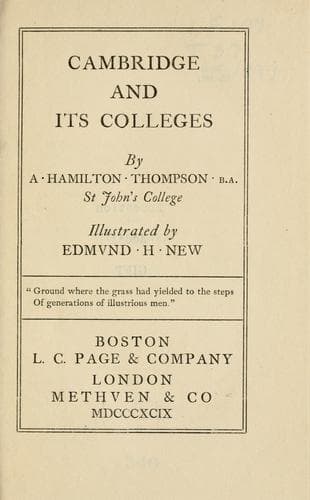
Cambridge and Its CollegesThompson, A. Hamilton (Alexander Hamilton)
History
Cambridge and Its Colleges
Thompson, A. Hamilton (Alexander Hamilton)
University of Cambridge
This same Mansel* came, some years later, to great dignity as Bishop of
Bristol and Master of Trinity. His mastership, from 1798 to 1820, closes
the eighteenth century. The most distinguished member of the college at
this time was the great Professor of Greek, Richard Porson,* who died in
1808 at the age of forty-nine. His beautiful Greek handwriting may be
seen in one of the cases in the college library. Otherwise, the scholars
of the last century are few and far between. Trinity was, however, the
great nursing-place for noblemen; and among the number of her sons may be
mentioned the famous Marquess of Granby (* Reynolds) whose head serves
as the sign for so many inns; John Jefferies Pratt, Marquess Camden and
Chancellor of the University (* Lawrence), George Henry Fitzroy, Duke of
Grafton (* Lawrence), and, of royal blood, William Frederick, Duke of
Gloucester (* Gainsborough, Romney, Opie), Chancellor of the University,
and Frederick Augustus, Duke of Sussex (* Lonsdale). A great statesman
of the day was Spencer Perceval,* who was assassinated in the lobby of
the Houses of Parliament. But, if we turn to men of letters and poets, we
merely find such men as the parodist, Isaac Hawkins Browne.*
Lord Byron received his education under Mansel. His career at Cambridge
would be scarcely worth recording, were he not Byron; for it is the
record of a foolish series of silly exploits and eccentricities bordering
on madness. The place of honour which is given to his statue in the
library always seems a little better than his merits. He occupied rooms
in Nevile’s Court, and contrived, during his residence, to irritate the
college authorities. Mansel, as master, had a very exalted idea of the
virtues of his position, and, from the anecdotes which are told of him,
must have made himself peculiarly unpleasant. He was the last master of
Trinity who combined that office with episcopal dignity. His successor,
Christopher Wordsworth,* master from 1820 to 1841, was brother to the
poet, and father of the late saintly Bishop of Lincoln.
Public-domain text, read in full here on John Shaqi.
Reviews
Reviews
No reviews yet
Be the first to share your thoughts on this work.
Elsewhere in the archive
Join the Discussion
Join the discussion
Sign in to leave a comment or review.
Sign InorCreate an account