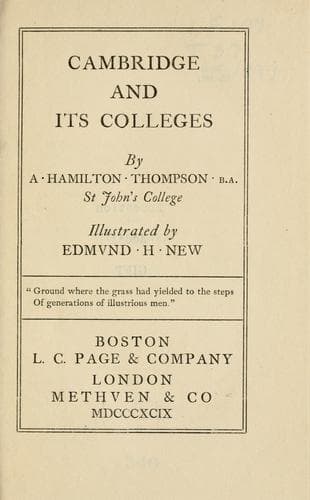
Cambridge and Its CollegesThompson, A. Hamilton (Alexander Hamilton)
History
Cambridge and Its Colleges
Thompson, A. Hamilton (Alexander Hamilton)
University of Cambridge
During the eighteenth century the state of the University was more
or less torpid. It was the age of combination rooms and good port,
of hard-and-fast social distinctions and formal gatherings. The
Universities, during this period, lost their touch with English life,
and were not even the forcing-houses of wit. This is especially true
of Cambridge. The first half of the century is absorbed in the great
quarrel between Bentley and his society. Bentley is unquestionably the
most commanding figure of his time at Cambridge; for Newton by this time
belonged chiefly to London. But Bentley was hated by the great company of
wits, who had, for the most part, little to do with either University.
Pope, Swift, Fielding and Richardson, the four writers who had the
greatest influence on their century, were connected with neither Oxford
nor Cambridge. And, from 1750 to 1790, there is very little to relieve
the general dulness which settled over Cambridge. Mr John Willis Clark,
in a delightful and only too short chapter, has revived for us the social
etiquette and pleasures of the period. But the pleasures themselves are
remarkable, for the most part, for their unconscious humour. And even the
epigrams, in spite of their uniform cleverness, are a trifle heavy.
The French Revolution woke Cambridge from this long sleep. It was an
active stimulant to the imagination. The fall of the Bastille had its
effect upon Wordsworth at St John’s and Coleridge at Jesus; its immediate
result, the general cry for independence, moved Byron at Trinity. The
romantic enthusiasm set in, and with it that love for a liberal education
apart from mechanical scholarship which is so prominent a factor in both
Oxford and Cambridge to-day. In short, the modern life of the University
began; Cambridge began once more to play its part in English intellectual
life. Wordsworth and Tennyson, of all poets, have done most to stimulate
the minds of their countrymen, and both owe no small portion of their
personal influence to Cambridge. And, side by side with this intellectual
revival, one cannot fail to notice the spiritual revival inaugurated by
the Wesleys at Oxford, and naturalised by Charles Simeon at Cambridge.
This simply means the awakening of the University to the other side of
her responsibilities. In the Oxford movement, which was the logical
result of this revival, Cambridge had very little share. Her traditions
were somewhat different from those of Oxford, and her theological
tendencies took what is usually known as a “broader” direction. Her
position is indicated by the names of F. D. Maurice and Charles Kingsley.
At the same time, her school of theology, under Ellicott, Lightfoot,
Hort and Westcott, has preserved its scientific basis and cannot be
surpassed in any University. And time would fail to tell of what triumphs
she has won in other fields. Darwin in biology, Thomson in electricity,
Adams in astronomy, are names which tell their own tale. With these main
Public-domain text, read in full here on John Shaqi.
Reviews
Reviews
No reviews yet
Be the first to share your thoughts on this work.
Join the Discussion
Join the discussion
Sign in to leave a comment or review.
Sign InorCreate an account